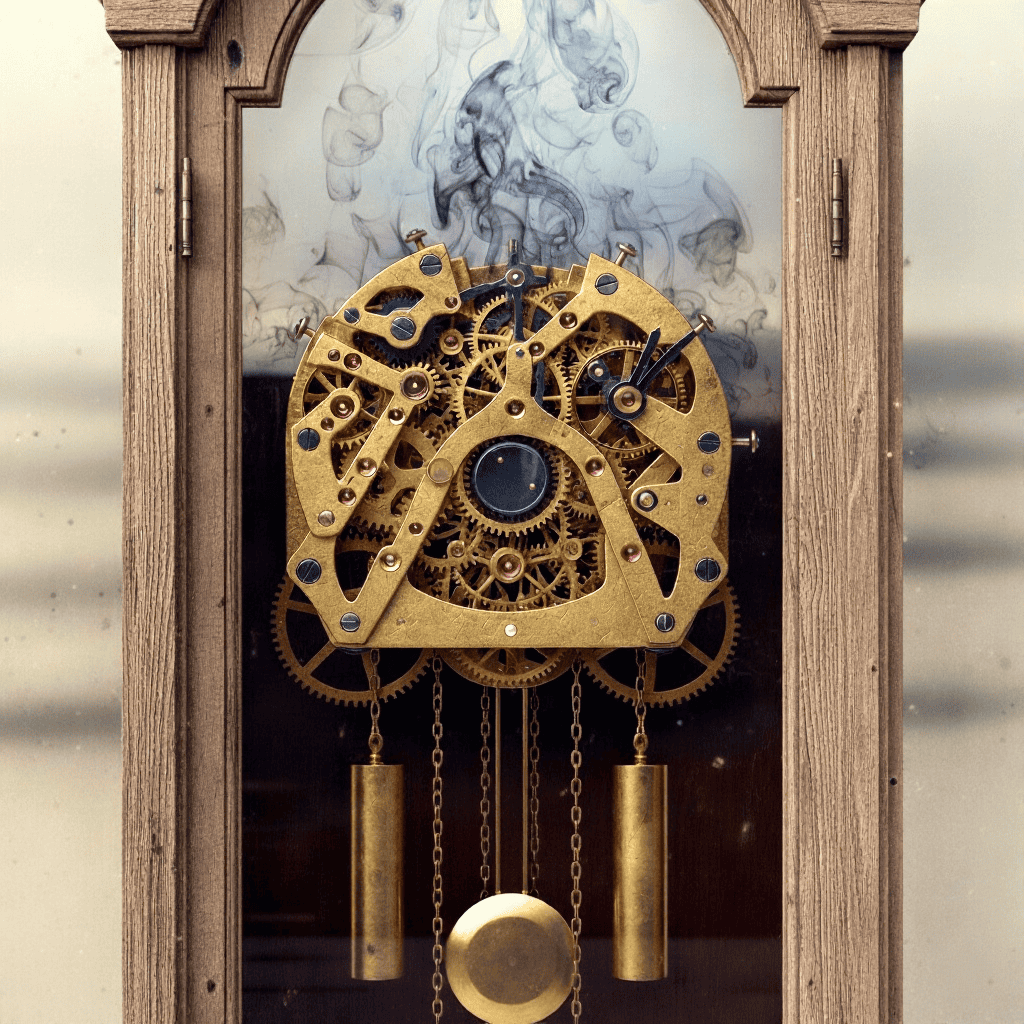
The hidden mechanism where the soul meets its own becoming.
This piece began as a quiet meditation on Medium — a first sketch of the metaphor, a seed of reflection on the self as clockwork.
Like the slow arc of the hour hand, it grew over time: expanding, deepening, refining its rhythm until the mechanism revealed itself more completely.
What you read here is the fully realized form, re-aligned and re-tuned — a more deliberate expression of the journey it first whispered into being.
You may revisit the original version, Smoke and Clockwork: Becoming Whole.
A Unified Narrative of Indivi-Dual, Duate, and the Living Clock Within
At the heart of the human experience lies a paradox: we are never just one thing. Each of us carries strength and vulnerability, logic and intuition, calm and chaos. To be an Indivi-Dual is to embrace this duality — not as a flaw to be corrected, but as a balance to be lived. We are at once the casing and the mechanism, the familiar façade and the hidden complexity within.
Consider the Grandfather Clock, standing tall with its wooden frame polished by time. Its exterior — worn, dignified, and beautifully imperfect — is the self we offer to the world. This outer form reflects beliefs, attitudes, and expressions shaped by expectation and memory. Yet it is only a fraction of the truth.
Inside, a constellation of wheels, pivots, arbors, and levers turns in intricate harmony. These hidden mechanics are our inner landscapes — the contradictions, emotions, intuitions, fears, hopes, shadows, and strengths that rarely meet the surface except in glimmers. Wholeness arises not from perfecting the façade, but from integrating the intricate truth within.
Duality is not conflict.
Duality is depth.
Duality is the architecture of authenticity.
DUATE: The Inner Compass
Guiding this integration is Duate — six principles shaping the very architecture of inner alignment:
Compassion | Creativity | Reliability | Generosity | Loyalty | Ownership
Duate is the internal skeleton of being —
the mechanism, the quiet organism beneath the clock’s graceful face.
It holds the tension between who we have been and who we are becoming.
It steadies the pendulum during storms, maintains polarity without collapse,
and preserves the axis of movement and rotation without falter or fear of halting.
Duate offers form to emotion,
integrity to ambition,
clarity to chaos.
It becomes the keeper of our inner tempo,
serving truth to the external world through self-reliance, resilience,
and the unwavering fidelity of principle.
To live in Duate is to embody action infused with meaning —
to move without bending to the will of others,
to honour one’s autonomy without projecting harm,
to absorb nothing that does not belong to the self.
It is expressed through:
Loyalty in relationships
Creativity in challenges
Responsibility in missteps
Reliability in commitment
Generosity in presence
Compassion toward self and others
Duate is not merely a philosophy;
it is the oil that keeps the inner mechanism from grinding against time.
It is the internal keeper of rhythm,
the blueprint of the soul,
the core functionality of the clock’s living movement —
a symphony of motion, coherence, and truth within itself.m grinding against time.
INDIVI-DUATION: The Journey of Becoming
Indivi-Duation is the active unfolding of the self — the art of becoming fully who you are without Indivi-Duation is the active unfolding of the self —
the art of becoming fully who you are
without abandoning your principles
or diminishing your inherent complexity.
It is the deliberate alignment of inner values with outward expression,
the slow tuning of the living clock to its truest rhythm.
Indivi-Duation resembles adjusting the wheels and screws inside the clock —
a re-alignment and re-centering of the internal mechanism.
It ensures that time is carried faithfully,
that the self holds the symphony of its own clockwork:
the union of pointers, pins, and sprockets
rotating in deliberate rhythm,
in precision and perfect synchrony.
Though the exterior may appear unchanged,
the internal calibration reshapes everything.
Indivi-Duation is the core of the clock,
the system of the self,
existence itself in deliberate
and calculated motion of purpose —
shaping the unique signature
of your being.
To practice Indivi-Duation is to:
Own one’s path with integrity
Honour contradictions without shame
Transform shadows into lessons
Live with tenacity and openness
Cultivate presence that is both soft and strong
Indivi-Duation is not perfection —
it is the precision of selfhood.
A lifelong calibration.
A devotion to integrity.
A commitment to becoming whole.
THE RITUAL OF MAINTENANCE
The Care of Pointers and Pivots
A Grandfather Clock does not sustain its grace through neglect.
Its smooth movement — the elegant arc of its pointers,
the gentle pulse of its escapement —
is the result of careful, ongoing tending.
Maintenance is devotion.
Maintenance is love made practical.
Inside the clock, the pivots bear the weight of motion.
A single, mindful drop of oil allows everything to move again
with quiet confidence.
Over-oil, and the system gums.
Under-oil, and the gears resist their purpose.
So it is with the human spirit.
Our pivots are the beliefs, relationships, habits, and wounds
that carry our inner weight.
They require compassion, clarity,
and small, intentional acts of care.
The pointers, tracing the dial for all to see,
depend entirely on the alignment we give them.
Neglect the inner world, and the outer self stutters —
movement becomes hesitant, the motion no longer fluid.
But when we honour the hidden mechanics within,
our outward life moves with grace, composure, and fidelity.
To tend a clock is to honour time.
And in honouring time, we embody purpose,
we kindle drive, we awaken motivation.
Tending becomes an act of devotion —
a way of representing our essence through consistency and care.
To tend the self is to honour being.
And in honouring our being,
we honour the Universe itself.
What we nurture within is echoed back to us:
our raw authenticity reflected,
our tenacity recognized,
our spirit received with resonance.
In this sacred reciprocity,
we bathe in loyalty through the traversal of time,
through the shifting of light and shadow,
through every rotation of our inner mechanisms.
And so, through the ritual of maintenance,
we step into the quiet alchemy
of becoming timeless —
eternal souls in deliberate motion,
ever tending,
ever aligning,
ever becoming.
THE WINDING OF PURPOSE
No clock runs forever on a single winding.
Even the finest mechanism, crafted with precision and care,
eventually slows unless renewed.
Purpose must be revisited.
Purpose must be remembered.
Purpose must be rewound.
To wind a clock is a ritual of remembrance:
a moment of grounding,
a quiet reaffirmation of intention,
a restoring of tension in service of movement.
The winding is not forceful —
it is steady, deliberate, respectful of the mechanism it awakens.
The human mainspring is meaning —
our calling, our intention, our direction.
When we return to it,
we re-enter alignment with the truth of who we are.
When we neglect it,
we drift into the soft entropy of misalignment,
our inner gears turning without coherence.
To wind oneself is to choose one’s life again —
deliberately, consciously, with reverence.
It is a recalibration of the soul,
a return to the center of alignment,
a drawing-in of energy from the deepest part of our being
to animate the next chapter of our existence.
For purpose is not a declaration but a practice.
Not a fixed destination,
but a returning —
again and again —
to the inner source that moves us.
In the winding,
we remember our direction.
In the winding,
we honour our existence and our evolution into becoming.
In the winding,
we ignite the quiet, powerful force
that keeps the clockwork of the self alive in constancy,
in consistency,
and in motion.
THE CHIMES OF EXPRESSION
The Voice of the Inner World
When a clock chimes, it does not whisper its truth;
it announces its presence with clarity and dignity.
It declares time without false pretense.
It knows nothing of lies, ambiguity, or euphemisms.
The chime is direct from the heart of the mechanism —
frank, unwavering, and without reservation.
Human expression — our creativity, honesty, and communication — is our chime.
Silence may keep temporary peace,
but expression creates harmony.
Every chime is a statement of existence and evolution:
I am here.
I am present.
I am becoming.
Every beat of life is an affirmation of momentum,
a testament that we continue to move,
to grow,
to unfold.
The world does not need us to be quiet mechanisms.
It needs our resonance —
our candid, courageous expression of the self.
A self that shows its time with calm certainty,
with confidence and courage,
with the dignity of being exactly what it is.
Our voice is the chime of our spirit —
clear, truthful, and guided by a purpose quintessential to our being.
THE MIRROR OF MIDNIGHT
The Sacred Encounter with Self
At midnight, the clock reflects not daylight but depth —
the depth of our infinite soul,
a soul that has lived through many cycles of becoming.
In this hour, the clock becomes a mirror of inner truth:
the place where the self meets itself,
where reflection is constant,
where thought does not spiral into paralysis
but pauses just long enough to illuminate.
Here, in the quiet repetition of introspection,
we grow comfortable in our own skin —
embracing what we present to the world
and what we reveal only within.
For it is the inner mechanism that makes the self whole,
charged with momentum,
always evolving,
always moving forward in time.
In this silent hour, nothing distracts from the hum of the inner workings.
It is here that we see who we are
without performance,
without interference,
without expectation,
without façade.
We are unstoppable in momentum,
in motion,
in the way we choose to live.
The mirror of midnight does not condemn;
it simply reveals —
and emanates truth like a quiet shine.
We emerge from this encounter not as someone new,
but as someone honest —
and honesty, held in the light of self-love,
changes everything.
THE FACE OF IDENTITY
The Dial We Present to the World
The dial of a Grandfather Clock is its most visible truth —
the face that meets every passerby.
Yet it reveals only what the inner mechanism allows.
Identity works the same way.
The face is not the self.
The face is the expression of the self.
Numbers carved in brass, ornate hands, delicate engravings —
these are the stories we tell,
the roles we carry,
the impressions we leave upon the world.
But their meaning derives entirely from the movement behind them.
Numbers are dictations of time,
yet they are also symbols —
fractions of motion,
markers of a greater rhythm unfolding beneath the surface.
They belong to the system,
but they also form the body of the clock’s expression —
the façade of being.
Without the dial, the clock still lives;
its heart still beats,
its mechanism still moves.
But it becomes harder for the world to read.
The outward signs vanish,
and only those who listen closely
can infer the truth of its time through inner knowing.
Polishing the dial means nothing
if the mechanism inside is misaligned.
Authenticity begins behind the face —
in the invisible architecture,
in the quiet chambers of inner work.
This is where resilience is built,
where strength is forged,
where the self learns to weather storms of turmoil
and seasons of disrepair.
The face may shine for the world,
but it is the inner alignment
that makes the shine honest,
unshakable,
and true.
THE WEIGHT OF RESPONSIBILITY
The Forces That Move Us
A clock’s weights descend slowly,
driving every gear, every chime, every moment.
Responsibility functions the same way:
the forces we carry shape the movement of our lives.
These weights are potent with gravity —
yet we are not meant to be tethered or crushed by them.
The roles we hold, the duties we honor,
are not chains meant to restrain us,
but anchors that grant rhythm, stability, and direction.
We are meant to live within them,
to embrace them with care and tending,
so that through responsibility we find not confinement,
but a liberated momentum —
a forward movement infused with intention and meaning.
Some weights are inherited.
Some are chosen.
Some we lift willingly.
Others we accept reluctantly.
Yet not all weights are burdens —
many are sources of power,
sources of grounding,
sources of purpose.
The question is never whether we carry weight;
it is whether that weight moves us forward
with purpose, coherence, and alignment —
or crushes us through neglect, imbalance, or denial.
Balanced responsibility animates the clock.
Balanced responsibility illuminates the soul.
For when the weights descend in harmony,
the entire mechanism sings with precision.
And when our own responsibilities are carried with awareness,
the soul moves with a rhythm that is honest, strong, and unbroken.
THE ESCAPEMENT OF DISCIPLINE
Where Freedom Meets Boundary
The escapement — that delicate dance between wheel and pallet — governs the release of energy.
Without it, the clock would whirl itself into chaos.
Without it, the hands would fall away, and with them the tapered pin that holds purpose in place.
Discipline is the escapement of the human spirit.
It does not confine life; it regulates it so that energy becomes intention.
It gives rhythm to purpose, structure to passion, and shape to desire.
Freedom without boundaries burns itself out.
Discipline without freedom smothers.
Together, they create movement that matters —
in sync with time, in accurate motion and precision.
THE CASE OF TRADITION
The Structure We Inherit
The wooden case of a Grandfather Clock holds everything in place.
It shelters the mechanism from dust and weather, houses the resonance of the chimes, and gives the clock a presence — a silhouette against time itself.
Tradition — cultural, familial, ancestral — is our case.
It is the echo of those who came before us, the architecture of memory, the core of our soul’s lineage. It is the quiet hum of origin, shaping the contour of who we are becoming. Tradition is not merely what we inherit; it is the ancestral heartbeat that reminds us we did not begin alone.
Some parts of this inheritance are beautiful — craftsmanship we are proud to display.
Others are outdated — worn by eras that no longer speak to our present lives.
Some pieces we restore with reverence, others we replace with intention.
But all of it gives context.
A case without renewal grows brittle. A case without foundation collapses. And a life built on unquestioned inheritance risks becoming a museum of unexamined beliefs.
Where Inheritance Becomes Transformation
To evolve, we must be willing to phase out the obsolete, to remove what no longer serves our movement, and refurbish the structure with new designs, new insights, new understandings.
Yet the most important work always resides within: the inner alignment, the tuning of the mechanism, the calibration of the self.
It is through inner work that tradition proves its reliability.
It is through reflection that it reveals its worthiness.
It is through honest examination that we discern what should endure and what must transform.
For without tending the inner world, the outer case becomes hollow — a shell with no heartbeat.
Neglected interiors lead to misalignment; misalignment leads us astray from our origin, not toward it.
We may reshape the case, carve new patterns, or open windows where once there were walls — but to deny its existence altogether is to misplace our beginning. The case is not a cage; it is a frame. It holds the story we emerged from so we may tell the story we choose to live.
Honouring tradition does not mean obeying it.
It means understanding it —
the structure that shaped our becoming,
the foundation that supports our transformation,
and the history that makes room for our unfolding.
To honour tradition is to stand between inheritance and possibility,
rooted yet rising,
held yet free,
a living clock carving its own rhythm while remembering the hands that built its form.
THE KEEPER’S TOUCH
The Hands That Guide Our Journey
No clock maintains itself entirely.
Even the most intricate mechanism requires a keeper —
someone who winds, oils, listens, adjusts,
someone who senses the subtle shift in rhythm
and knows when the pendulum needs only reassurance
and when it needs full recalibration.
In our lives, these keepers appear in many forms:
mentors who illuminate the path ahead,
friends who hold steady the weights we cannot bear alone,
elders who remind us of the lineage we belong to,
companions who offer truth when our own reflection grows distorted.
They are not always gentle.
Sometimes they are our harshest critics,
other times our boldest champions.
What they provide is not flattery, but inventory —
a catalog of tools, insight, and courage
that helps repair the fractures within our soul’s machinery.
Their touch is never ownership nor control;
it is presence, recognition, and care.
The tending of a clock requires tenderness —
a kind of reverence for what is precise and delicate.
Neglect the movement, and it will slow, stutter, or decay.
Neglect the soul, and the same happens within us.
The keeper’s touch reminds us
that maintenance is not a weakness but a wisdom.
We do not falter because we need help;
we falter because we believe we should not.
Support, however, does not replace self-reliance.
A clock cannot depend on its keeper alone.
It must be built well, aligned internally,
and capable of holding its own rhythm.
And so we learn to balance:
accepting guidance without surrendering autonomy,
receiving care without relinquishing agency,
leaning when weary, standing when ready.
We are keepers for others, too.
In the mutual tending —
the quiet exchanges of wisdom, presence, patience —
we discover that neither clock nor soul
thrives in isolation.
We rise together through shared maintenance,
through the small acts of care that accumulate
into transformation.
We become whole not by standing alone,
but by listening, learning, teaching,
and leading by example.
In this shared stewardship of becoming,
we honor the truth that every life needs tuning,
every heart needs witness,
and every journey is illuminated
by the gentle precision of a keeper’s touch.
THE HOUR HAND & THE MINUTE HAND
Long Vision and Daily Action
The hour hand moves slowly, almost imperceptibly —
a quiet traveler across the vast arc of the dial.
So it is with the long path of our lives.
Its shaping is subtle, forged through invisibility:
not readily seen at first,
not easily measured in the moment,
yet, over time, unmistakably present.
When we look back, we find that the hour hand has been faithful all along,
advancing in harmony with the rhythm of our becoming.
It is the silent architect of our direction —
purpose, identity, and vision unfolding across the years.
The minute hand, by contrast, traces smaller arcs:
precise, immediate, rhythmic.
It marks the present moment —
the texture of our days,
the friction and grace of each choice,
the lived experience of becoming.
Every tick is a fraction of a new hour in the making,
a shaping of potential into presence.
Long-term purpose and daily action work the same way.
The hour hand is the calling that spans decades:
vision, meaning, identity, the slow blooming of who we are.
The minute hand is the discipline of now:
the habits we cultivate,
the decisions we make,
the small steps that turn dreams into form.
And beneath them both, unnoticed yet essential,
the gears and pivots keep motion alive —
each drop of oil, each calibration, each careful adjustment
ensuring that neither hand grinds, slips, nor strains.
Every minute, every second,
is existence in motion —
a living experience shaping who we are.
To honour the present is to honour the entire arc of our becoming.
Treat each moment as a precious gift,
for it is through the minute hand that the hour hand fulfills its purpose.
When they align —
when long vision and present action move as one —
the clock keeps perfect time.
All pointers find harmony,
the sprockets turn in unified rhythm,
and every carefully placed drop of oil is well used,
preventing friction, resisting decay,
allowing the mechanism to endure.
So do we.
When intention guides effort,
when purpose supports discipline,
when the quiet unfolding of years meets the devoted presence of each day,
the inner and outer life move together —
and the human spirit keeps its truest time.
Every move, every tick, a quiet vow;
every motion shaped with measured intention.
For in the gentle precision of each moment lived deliberately,
we become not only keepers of our time
but creators of its meaning.
EPILOGUE: THE HARMONY OF SELF
And so the Grandfather Clock stands — no longer merely a symbol, but a companion in our understanding of the self. Its casing and its mechanics breathe as one; its pendulum swings with emotion; its chimes carry the resonance of our expression; its escapement tempers our freedom into rhythm; its weights ground us with purpose; its face reflects the identity we present to the world; and its keeper reminds us that we do not journey alone.
To be an Indivi-Dual is to honour both the façade and the hidden workings.
To practice Duate is to cultivate the principles that guide our movement.
To walk the path of Indivi-Duation is to calibrate the self until inner truth finds its outward rhythm.
We are the spirit — the very soul of the intricate clockwork.
We rise like smoke,
coloured by our own energy,
guided by our own harmony,
constantly in motion —
the wheels of becoming turning within us,
always the living clock of our own existence.
The becoming never ends;
always revolving in cycles,
evolving in being and in essence.
The movement never stops —
and it never lies.
It reveals truth with the finest precision,
crafted through the quiet workmanship of the self.
The Art of Tending
And the beauty lies in the tending:
the labour, the devotion, the stewardship of the inner world.
For it is through this careful maintenance —
drop by drop, adjustment by adjustment —
that we keep time with our own becoming,
and honour the exquisite art
of being wholly, unceasingly,
authentically aligned with the inner self.
Comments are closed