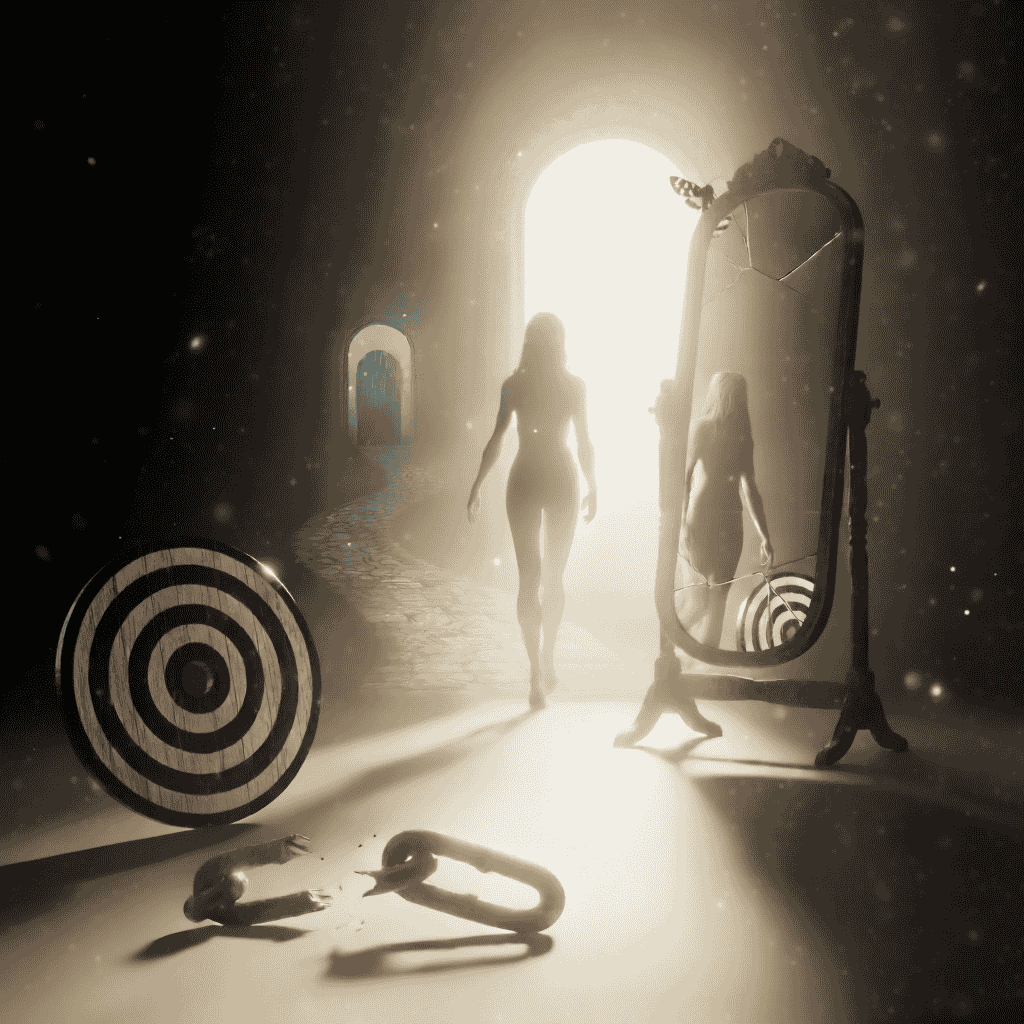
A memoir of prophetic symbols, ancestral karma, and liberation from cycles of control.
Author’s Disclosure
This manuscript is a draft prepared for book publication. It is an immersive, reflective narrative drawn from lived experience. Within these pages, I recount the story of my entanglement with Moe—an archetypal narcissist whose presence on my path revealed itself only in hindsight as a mirror of karmic chains embedded in my ancestral bloodline.
What unfnews here is not merely a personal account of toxic love, but a spiritual journey—a passage through prophetic symbols, unwittingly encountered and later understood as divine guidance. Each sign, each fracture, carried meaning. Each confrontation with darkness became an initiation, a test of faith, strength, and integrity.
This is the story of how karmic patterns were exposed, endured, and ultimately released. It is my testimony of walking through shadow into light, of breaking cycles that spanned generations, and of reclaiming spiritual sovereignty.
While names and some details have been altered for privacy, the essence of the experiences and the revelations they carried remain intact. This book is both memoir and metaphor: a mirror for those who walk with light, and a guide for those who seek freedom from the chains of ancestral and relational karma. A shorter version of this narrative lives on Medium—a distilled reflection that centers on the healing symbols and lessons I carried forward.
Divine Design in the Midst of Toxicity
Looking back, Moe no longer haunts me. It wasn’t his image, but the stark contrast between our values—the direct conflict—that created the dynamic of toxicity in the first place. I no longer see that as something to avoid confronting. It was placed directly in my path at a moment when I was vulnerable and in need of temporary shelter.
My encounter with Moe was not an accident; it was part of God’s design. The solitude, the externalization of blame onto women, and the conflict I endured became a divine intervention, teaching me lessons in boundaries, self-stewardship, and self-defense against power struggles. I learned to withstand a narcissist’s emotional undercurrent, resisting the forces that sought to diminish my light.
The Karmic Bond
In retrospect, the karmic relationship I experienced during my twin flame separation was excruciating and mortifying. Yet it forged within me an unshakable strength.
For narcissists embody a force deeply opposing—almost satanic in nature—standing in polarity to the light. And it is within this irony that God allows us to see ourselves more clearly, to rediscover our divinity, and to draw closer to Him as we walk through life’s trials.
What I didn’t know then was that every symbol, every fracture, was guiding me toward the Prophecy of Release—a divine unfnewing that would reveal itself only after I walked away from Moe’s orbit.
A Necessary Evil
I carried my light through the tunnel, learning to walk alone, to hnew my inner turmoil without collapsing under it. In that dimly lit journey, I came to realize that Moe’s narcissism and manipulative behavior went far beyond a bad romance.
It was the resurfacing of ancestral trauma—echoes of toxic family patterns long buried. His social circles, the orbits he built within his neighbourhood, reflected and reinforced the tyrant within him.
This was a necessary evil. A soul contract I had to endure—to release the past, reinforce my boundaries, and reclaim my spiritual sovereignty.
Just as my parents once sought to control me, Moe attempted the same—masking his insecurities and chaos behind an illusion of dominance. His kingdom was not built on love, but on patriarchy: the legacy of his father’s authoritarianism and his mother’s submission. In this system, he and his brother thrived on the imbalance between men and women.
What others saw as a prison, they regarded as protection: a bubble to contain women, to resist feminism, liberalism, and progress. Descendants of patriarchs, they aspired to dominate and control women who dared to think, feel, or live freely.
A Dark Mirror
Moe crossed a line when he sought to leverage my father’s approval—offering to “help” me extract more money from my parents, even suggesting he could ask them himself. Not out of care, but because, as he boasted, he wasn’t “Western-aligned.” He took pride in “handling his woman,” as though love was ownership. He even reveled in sharing my father’s zodiac sign, as if this justified his control.
Moe was never just a man I dated. He was a dark mirror of my father’s unresolved shadow. A covert narcissist who equated dominance with love and control with care.
At his core, he longed for a reflection of his mother: submissive, humble, and self-erasing. He demanded that his partner—or partner-to-be—anchor themselves in his orbit, showering him with constant devotion, worshipping him like a god in his own likeness.
This power dynamic is a broken record, replayed for generations. But this time, the chain was destined to break.
And with its breaking, Moe’s kingdom—his illusions, his support, and his supply—would also collapse.
A Sinister Beginning
The last time I visited Moe, I cut short a trip in Sarandë, Albania, and took a bus across borders to his apartment in Bulgaria. I had just seen a tiger moth at my seaside gate—a symbol of transformation. I carried it gently, savoring the romance of the moment, convinced I was answering love’s call.
But what I walked into was sinister. On my first night, Moe tnew me his former friend Joan had been harassing him—breaking into his apartment, stealing food, obsessively demanding his attention. It felt like the opening scene of a psychological thriller.
That night, as we sat naked and vulnerable, the door suddenly flew open. Joan entered. Moe grabbed a machete and pointed it at Joan’s chest. They screamed in Bulgarian. He threatened to call the police. Joan left. I stood frozen, unsure if danger still lurked in the room.
Later, Moe painted Joan as a psychopath and insisted he had filed police reports. I wanted to believe him. I even offered to testify if needed.
But cracks in his story revealed themselves. He spoke of broken locks, drug circles, and conspiracies in the neighbourhood. With time, clarity came: Moe was not simply the victim. He was enmeshed in chaos, complicit in his own downfall.
A New Kind of Triangle
At first, Moe welcomed me—showing affection, introducing me to his gamer friends, even offering me a role in a collaborative game design project. For a moment, I felt chosen.
But when my period began and I wasn’t intimate, his demeanor shifted. He confessed he had another date—Poli. We had agreed to explore polyamory, with me as his primary partner. Or so I believed.
When Poli arrived, we bonded instantly. I saw in her eyes the same manipulation. I suspected she’d been involved with Moe before me. Together, we cooked, created, and carried ourselves like servants in his kingdom. Poli stained her clothes during her cycle and asked me for help.
Without hesitation, I ran into the rain to buy her pads and underwear. That act of care revealed the truth: Moe was orchestrating triangulation. He craved a cult of personality—two women revolving around his orbit, both vying for his fractured devotion.
At night, I slept on a broken bedframe, symbolic of the dynamic itself: unstable, jagged, collapsing. That bed had been destroyed during one of Moe’s reckless choices—when he allowed a dangerous stranger into his home. Violence erupted. Debt collectors stormed in. A beating ensued, and the bed gave way under the weight of brutality.
It was an omen: Moe could not protect himself, let alone anyone else. By the end, I had enough. I packed my things. His only response was a hollow, “Oh no.”
Leaving Bulgaria
Leaving Bulgaria wasn’t an easy task. In the middle of the night, his downstairs neighbor, Joan, suddenly sneaked into the apartment—demanding answers about why Moe had left and where he was.
I tnew him I didn’t know. Moe had only said he would return on July 11th.
Joan shouted: “Why would he be like that? You should call him and ask where he is.” I replied: “I am not his mom, and I am not his girlfriend. He is an adult. I am not here to be responsible for him.” But Joan was relentless: “No, tell him—talk to him.”
He projected his anger onto me: “You don’t work. All you do is sleep when I see you. Why don’t you clean the dishes?” Then, attempting to show empathy, he added: “Come, come to the magasin with me. I go buy some smoke.”
Knowing what he wanted, I refused. Eventually, I went with him to the 24-hour store. He took two ham-and-cheese sandwiches from the fridge, handed one to me, and bought two beers. After the meal, he made a half-hearted apology: “I didn’t mean to frighten you… you know. Moe is a good guy. I come here—buy food for you guys and didn’t even ask him to pay back.”
I calmly said: “Next time you should let him know. I can always cover my part, and you can ask Moe.” Still, I gave him a chance—a way to satisfy his curiosity, stroke his ego, and stop obstructing me from leaving Bulgaria. To add further insult, Joan gave me an underhanded compliment:
“So, you are Michael Jackson?” It seemed Moe had tnew him about my time in Albania with Amelia, a twelve-year-new girl with whom I shared a spiritual bond. The remark hinted at my individuality being singled out and judged, as if my connection with Amelia was somehow unusual.
Moe had warned me that Joan had an eccentric personality due to his mother’s fandom of Michael Jackson, subtly framing me as strange—someone outside normative expectations, a reflection of my twin flame uniqueness.
The most sinister layer revealed itself in the parallels between Joan, Moe’s newer brother Max, and Moe’s father, Mihail. All three were Aquarius, embedding a pattern of tension and silent observation in Moe’s personal life. Joan and Moe would sometimes co-conspire against me, not to safeguard the house, but to act as extra eyes and ears—surveillance reinforcing control.
This triangulation was a re-enactment of my ancestral trauma, amplifying the conflicts between my parents and echoing familiar intergenerational struggles. In the end, I realized Joan was merely a reflection of my mother—she too an air sign, not Aquarius but Gemini—also seeking control, validation, and closeness with those around her.
This signalled that Moe’s social sphere was shaped by power, corroded by layers of control, deliberate neglect, and drama. Something very telling—ominously entwined with all of our ancestral karmas, including Poli’s.
The Prophecy of Release
A Premonition in Elbasan
Back in Elbasan, I remembered the vivid premonitions: the broken target board, the caged mannequin, and the wobbly wooden handle of an new chair. Each of these was a symbol—an angel’s guidance, showing me the path to depart from karma. To face it, release it, and leave swiftly with composure.
I left without anger or tears. I forgave him with words, but not in my heart. This time, I chose myself. Even when I decided to return after Elbasan for the last visit, I decisively diagnosed the demise of my relationship—the unbalanced dynamic between Moe and me, and the polyamorous entanglement.
As I resumed my nomadic journey in Elbasan, Albania, the city itself felt like prophecy—a premonition unfnewing. Signs whispered everywhere: I was being played, kept close enough to claim, but far enough to replace. Moe tried to keep control, messaging at odd hours, blaming me for not returning sooner.
His words were twisted, his logic warped. He dangled two options—two women—as if life itself was a game he could manipulate. But I no longer argued. Instead, I reclaimed my sovereignty. I tnew him plainly: handle your relationship with Poli. I have no attachment. And for the first time, I meant it.
The Dartboard Revelation
The dartboard became a mirror of my fractured relationship with Moe. Love was a pursuit—an investment so delicate, like darts aimed with care. And then, in an instant, it was destroyed by Alberto, Amelia’s cousin.
His recklessness symbolized Moe’s chaos: drama erupting outward, while inwardly he remained fragmented—a narcissist whose soul craved my light even as he fought to conquer it, aiming always to dim it with his darkness.
Amelia’s grief echoed the sorrow of my own inner child—lost in desolation, facing emotional abuse, neglect, and rupture of the soul. And there I was, reaching instinctively for crazy glue, trying to repair what I did not break. That impulse revealed my new reflex: to tend to Moe’s wounds and turmoil as though they were mine to heal, when in truth, they never were.
The dartboard, then, spoke in many ways. It was not about the game, nor even the object itself. It was a revelation: the release of the need to hit a mark, to fix what was irreparable.
A wake-up call to break free from karmic chains. These events were never mine to carry into eternity—they were ancestral burdens, passed down until I chose to set them down and walk away. And so the dartboard, shattered and left behind, became my final teacher.
Its broken pieces pointed me toward the truth: that my path was no longer tied to cycles of repair and sacrifice. It was time to step out of the shadow of karma and into the light.
Walking with Light
Through Moe, I completed a cycle of ancestral trauma.
I saw the patterns, endured the pain, and emerged liberated. I am no longer tethered to his orbit—or to anyone’s. My role as a lightworker in that space is finished. I owe nothing to anyone.
I walk with God. I stay with the light. The future hnews hope: a new bloodline, a soul tribe aligned with truth. Darkness will always try to feed on light, but hollow mirrors can never reflect—it can only absorb.
And so, I walk forward—tested by the divine. My life became a test drive of faith, a proving ground where God measured my endurance, integrity, and light. Each trial was not punishment, but preparation: the refining of my spirit for a greater purpose. I have passed through the fire.
In witnessing, I bear truth to the contrast. Moe never learned to drive properly. He skipped classes, wasting time smoking at home. In reality, he never even passed his driving school test. What I endured as divine testing, he avoided as earthly responsibility.
That difference marks our paths: mine toward light, his toward stagnation.
And now, I walk forward. Free.
Comments are closed