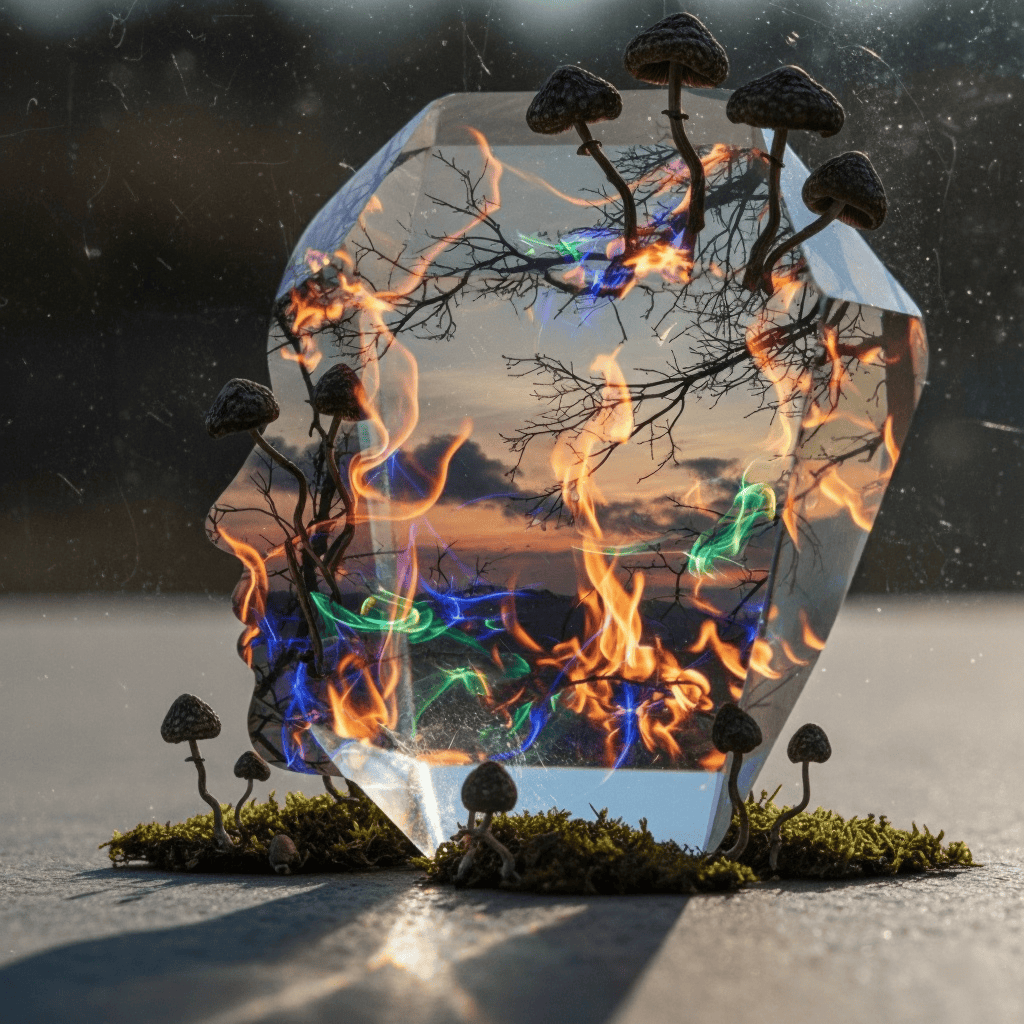
A festival beneath the stars became an initiation — a mirror of the self through rhythm, art, and surrender. Between awakening and intoxication, I found that not all revelations come from the trip; some arise in the quiet collapse of what was once beautiful.
Prologue: The Art of Returning
Every journey through awakening carries its own descent — the moment when the trance fades and we begin to listen to the echoes it left behind.
Between Awakening and Intoxication: The Island of Mirrors captured the ecstatic unravelling — the lessons found in reflection, projection, and resonance amid the chaos of sound. But awakening is never the end; it demands embodiment.
Integration: The Return after Inhabiting as an Islander begins here — in the quiet after the festival, where music becomes memory and symbols take root in flesh. It is the moment of return, of re-entering the body and the world with new eyes. This piece is not about escape, but about continuity — how the island’s rhythm lingers in the heartbeat of daily life, how the sacred persists within the ordinary.
To trace the origin of this metamorphosis — the raw unfnewing of human experience — one can return to the original reflection, The Oracle of the Wobbling Tent, where the disillusioned ego was first dismantled and reshaped into a vessel of resilience, love, and hope — its mirror-soul counterparts evolving like interlocking sprockets in motion.
From this grounding, The Genesis of Sound looks back — tracing the first pulse of creation itself, the eternal resonance that binds art, chaos, and cosmos. Yet the continuum does not end there. Where Genesis sang the universe into vibration, The Temperature of Frequency: From Ice to Fire descends into the thermodynamic afterglow — where sound becomes heat, and consciousness discovers its own physics.
It is the elemental sequel, the embodiment of resonance as energy in motion — the same pulse now burning through matter, light, and memory.
Together, these reflections form a living cycle: awakening, return, remembrance, transmutation — the perpetual tuning of spirit through vibration, fire, and form.
Preface: Threshnews Between Worlds
There exists a thin shimmer between transcendence and excess — a place where awakening and intoxication blur into one another.
This is a record of that threshnew: a festival that became an oracle, a mirror for everything within me that still longed to dissolve and return.
Through conversations with seekers, artists, and one man named Ivan who believed psychedelics could tune consciousness like an instrument, I learned that every altered state carries both revelation and risk. What I found was not an escape from reality, but a confrontation with it — raw, luminous, and humbling.
This is a story of mirrors, music, and surrender — of how even in chaos, the soul finds its own reflection.
The Festival: A Living Oracle
I once went to a music festival that turned out to be far more than dancing under starlight. It became a living tapestry of mirrors, karmic lessons, and energetic reflections. Every interaction, every shared joint, every beat on the dance floor seemed to carry a symbolic message — as if the universe had arranged a curriculum of resonance, challenge, and boundary-testing designed to reveal my power, my discernment, and the kind of connection my soul truly longs for.
For anyone walking the twin-flame journey or carrying fiery placements in their chart: you are not alone. We’re all navigating this path of entanglement, testing, and love that disciplines itself even as it radiates outward.
The festival wasn’t just about chakras, meditation, or even the pounding heartbeat of psytrance. It felt like surviving on a small island where community was both refuge and trial. Families camped alongside DJs, painters, vendors, and seekers. Spiritual concepts were tested in the grit of reality — and every bond, fleeting or deep, carried a lesson.
Ivan: Resonance and Psychedelic Inquiry
Ivan spoke about psychedelics the way some people speak about prayer — not as escape, but as inquiry. His words wove the experience into something deliberate, almost sacred: a curriculum of self-revelation disguised as altered perception. For him, each trip was a mirror held up to the unconscious — an invitation to dissolve, observe, and return changed.
He insisted that even those who stayed sober were not immune to the field — that proximity to the tripping mind opened a subtle contagion of perception.
“You’ll start to see the colors shift,” he said, “feel the air thicken, sense the geometry behind sound.” He believed energy worked like osmosis — that the collective vibration of an altered crowd could tune sober minds into higher frequencies.
To me, those heightened sensations felt physical, not spiritual — the body reacting to overstimulation, not awakening. But Ivan disagreed gently, his conviction quiet and assured.
“If you try enough shrooms,” he said, “the same type, in the same setting, with discipline — your neural pathways will start to recognize the pattern. You’ll open up to new dimensions.”
He spoke like a scientist and mystic in one breath. In his worldview, psychedelics weren’t tools for escape but keys for remembrance, unlocking the architecture of consciousness that ordinary perception hides.
My Inner Lens
I tnew him I didn’t see the purpose. Neither shrooms nor acid. I don’t need to alter my consciousness to find out who I truly am. I am living in the dimension of an in-between reality. My consciousness already bends and refracts without the aid of substances. I live inside a prism — one spirit split into two forms, my twin existing somewhere parallel while I navigate this plane. There are days when I feel us both breathing through the same membrane, separated only by density. It’s as if I already inhabit two frequencies at once: the earthly and the etheric, both trembling in my chest.
Even my mind — with its quicksilver attention, its restless leaps and spirals — feels like a psychedelic landscape. My ADHD isn’t a defect; it’s a hypersensitivity to pattern, to sound, to energy. I see too much, feel too fast, think in simultaneous threads. For me, that is the altered lens — a blessed handicap, a built-in portal that fractures time and emotion into kaleidoscopic shards.
To me, they were just mushrooms — tasting like the ordinary dried ones my grandmother used in Chinese soups, woody and faintly bitter. Nothing mystical, nothing extraordinary. Just a fragment of nature’s chemistry, once revered by tribal groups, now repackaged for modern seekers chasing transcendence.
I couldn’t help but think how ancient this ritual truly was — people across civilizations consuming the earth to converse with the sky.
While Ivan chased patterns through visions, I found mine in the mundane — the rhythm of breathing, the quiet observation of what is. Perhaps that’s the real difference: some open the door through medicine, others through memory.
The Sculptor and the Collapse
A Mirror in the Dust
Later, as I walked past the installation zone, I found the Bulgarian sculptor crouched beside what remained of his wooden centerpiece — fragments scattered, nails half-torn, his hands streaked with dust. Watching him dismantle his own work felt strangely familiar, as if his labour mirrored the very process Ivan described — breaking form to access essence.
He tnew me that unlike Mo:Dem in Croatia, where the organizers preserved the sculptures after the festival, here everything was left to decay. “They just leave things be until they need you to deliver the piece,” he said, his voice laced with exhaustion. “I could refine it, but they didn’t give me enough time. Another guy was supposed to help — an Albanian who barely speaks English, only a little Italian. So now it’s all on me to make everything happen and tear it all down.”
Undoing as Creation
Yet where Martin sought expansion through the mind, the sculptor found truth in undoing. Each plank removed, each splinter freed, was an act of humility: the art returning to earth, the artist relinquishing authorship.
In that moment, I realized both paths — the psychedelic and the physical — pointed to the same revelation. Whether through vision or through decay, everything beautiful must eventually unmake itself to stay alive.
The Elegy of the Hands
He pressed the hammer against the beam and struck with precision — not rage, but acceptance. Destroying the wood, tearing the nails apart; each blow a soft percussion against the echo of his own creation. Dust gathered in the late-afternoon light, dancing like tiny ghosts of memory.
There was no audience now, no music, no applause — only the slow unravelling of something once worshipped. Not stored, not preserved for the next season, but destined to be reborn through ruin. The festival’s illusion of eternity faded with every plank he removed. I realized how similar it was to Ivan’s idea of consciousness — dissolving to discover what lies beneath.
Yet this felt purer to me: a surrender that required no substance, only presence.
Dust Returns to the Earth: All Things Find Their Way Home
I thought about how everything sacred eventually becomes soil — the tents, the lights, even the vibrations that once moved our bodies. The sculpture’s collapse wasn’t tragedy but translation: spirit back into matter, matter back into silence. Perhaps awakening is not expansion outward, but implosion inward — the graceful dismantling of what no longer needs to stand.
As the last piece fell, the sculptor brushed his hands on his jeans and smiled faintly, as though he’d just witnessed a quiet funeral for his own ego. Around us, the island sighed in relief. The wind carried the scent of dust and sea salt. Somewhere in the distance, a leftover bassline pulsed one final time — a heartbeat fading into the earth.
Epilogue: The Mirrors Remain
Echoes Pulsating Beneath the Skin
When I left the island, the music still echoed in me — faint but alive, like a pulse beneath the skin of memory.
The festival had been a mirror labyrinth, each face, each encounter reflecting a fragment of the self: Ivan’s introspection, Viktor’s performance, Nikola’s joy, the sculptor’s surrender. Even the dismantled wood carried a whisper — a reminder that everything we build in light must one day return to shadow, only to rise again in another form.
It lived only for the moment, yet in that fleeting pulse was something eternal. Things appear not for permanence, but for the meaning and consciousness that inhabit them.
The Convergence of Being: Where Existence Meets Awareness
I realized that awakening isn’t the climax of transcendence, but the quiet endurance of being — to hnew joy and loss, fire and stillness, without breaking. The mirrors had done their work.
What remained was presence: unadorned, untripped, alive.
For I’m tripping myself in every trip of my life — just as Ivan said, “I am tripping while he trips…”
Perhaps I am always tripping — not on substances, but on existence itself.
Contagion of Energetic Beings
Co-existence of energy is infectious. It embodies and affects every person around us, shaping the very synchrony and unfnewing of events — subconsciously, within the blueprint of our souls. An invisible path, paved by the unconscious self.
Rays of Chaos, Reprieve, and Allegory
We live in a prism — a colorful one — each of our souls reflecting the others, inadvertently projecting and receiving, all conjured together as a symphony of chaos, reprieve, and allegory.
Even when I am sober, I am still tripping through the lives and reflections of those around me — still learning, still dissolving, still returning to myself.
— ✦ —
Written on November 2, 2025 — sixty days after the psytrance festival ended.
Comments are closed