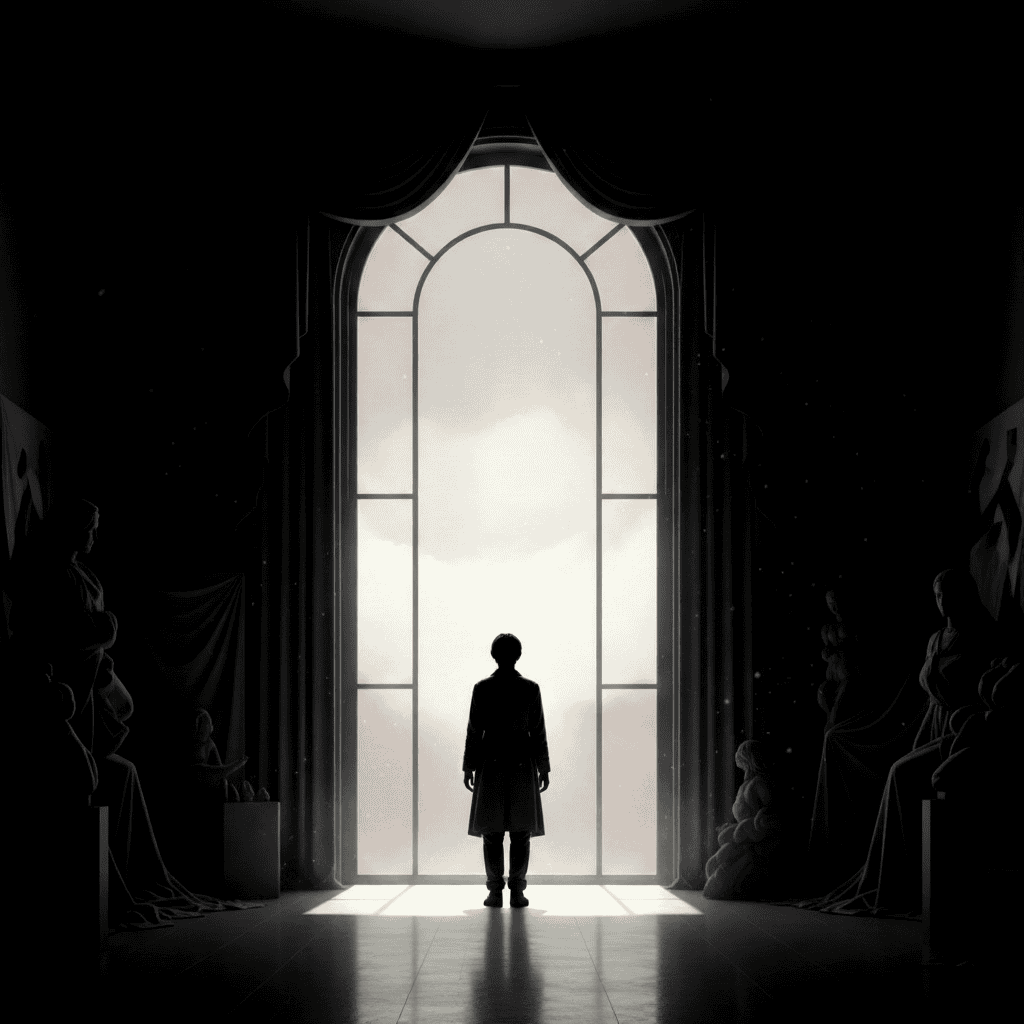
A lone artist standing before the light — the moment where creation, identity, and legacy converge in silence.
On the longing to be remembered, the terror of vanishing, and the quiet truth of what endures.
On the Inner Life of the Artist
An inquiry into the silence, struggle, and spirit that shape the unseen work.
Every artist walks with an invisible companion — a living, breathing inner world where doubt and devotion intertwine. It is here, in this quiet terrain beneath the surface of creation, that the true work begins. Long before a piece is witnessed, judged, forgotten, or remembered, it exists first within the private chambers of the artist’s own becoming. This is the realm where legacy is born — not in monuments or archives, but in the fragile, luminous space between creation and disappearance.
This reflection continues an ongoing series exploring the interior world of the artist — the unseen spaces where creation stirs, where struggle and stillness converge, where truth ripens in silence before it ever takes form. It follows the arc established in the earlier works: Against the Gaze: A Manifesto on Creation, Ego, and the Courage to Resist; The Sovereign Path of the Artist: A Meditation on Suffering, Solitude, Devotion, and the Sacred Truth of Creation; The Discipline of Creation: Devotion and the Architecture of Authentic Art; and The Role of Silence and Stillness: Where Absence Becomes Presence, and Creation Finds Its First Breath.
Together, these pieces form a map of the artist’s inner life — a landscape shaped not by recognition, but by consciousness, sincerity, and the quiet courage to create despite uncertainty.
I. The Shadow of Disappearance
Every artist, no matter how grounded or devoted, eventually encounters a quiet tremor within — a fear that their work, their voice, their very presence may disappear. This fear does not arise from vanity but from vulnerability, from the awareness that creation is fleeting, that the world forgets quickly, that even the most luminous works dissolve into time. Artists fear their work may vanish like mist — slipping into obsolescence, swallowed by oblivion without remembrance or trace. They fear it will be devoured by systems obsessed with novelty and endless competition.
The fear enters subtly:
in the pause before releasing a piece,
in the ache of being unseen,
in the question of whether any of it will matter once we are gone — whether the work holds value, whether it contributes to humanity, whether it will remain for those capable of truly seeing.
Legacy becomes both longing and burden —
a desire to leave an imprint, a hunger to be recognized and remembered,
and a fear that the imprint will fade before it is even understood.
This fear is not a flaw in the artist’s character;
it is part of the human condition.
It is the artist’s instinct to remain potent and relevant in their creation, to make work with impact and intention, to create from the inner force that gives art its truth.
To create is to touch the ephemeral, to bring impermanence into form, to engage the self — turning thought into process and process into being. To reveal the inner world is to risk its disappearance, especially when the language of sincerity is uncommon, unseen, unfamiliar to the collective consciousness.
And yet, it is precisely this impermanence that gives art its gravity — its rarity, its rebellion, its quiet defiance against time.
II. The Myth of Permanence
Society teaches us that legacy is monumental — tall, immutable, admired from a distance. But true legacy is rarely monumental. It is intimate, subtle, woven into the ways one life influences another. Art itself is seldom lasting. In contemporary culture, it trends, flares, fades. It loses luster once exposure exhausts its novelty. And yet, sometimes it resurfaces through later adopters, through rebellious youth who rediscover the sacredness buried in forgotten works.
Originality of voice, emotional depth, and meaning — these are what allow art to outlive its moment. Even if it disappears from the marketplace, art preserves something ancient, something raw, a truth waiting for the next hunter to find it.
The myth of permanence traps the artist in illusion. Art does not stay. It lingers briefly in memory, drifts on cultural winds, hides beneath conformity. It may be revived, but never with certainty.
Frescoes crumble.
Manuscripts decay.
Books are banned and burned.
Paintings darken.
Sculptures collapse.
Drawings vanish into humidity and dust.
Entire lineages dissolve into unrecorded history.
And still — art endures in another form:
in meaning, in transformation, in the ways it alters human consciousness.
A single sentence shifts a mind.
A brushstroke changes a mood.
A sculpture awakens a forgotten inner landscape.
A sketch echoes through unspoken consciousness.
Legacy is not the artifact.
Legacy is the impact.
Legacy is the change.
III. Recognition, Obscurity, and the Artist’s Wound
Many artists carry a peculiar wound — the ache of being unseen, intertwined with the ache of being judged. This wound forms long before the work becomes public. It is rooted in childhood misrecognition, early misunderstandings, the longing to be understood by even one person, fully and without distortion.
When the world fails to witness the work, this wound deepens:
Am I disappearing?
Does any of this matter?
If no one sees it, does it exist?
Do I matter at all?
But obscurity is not erasure.
Silence is not negation.
The absence of an audience does not diminish the truth embedded in the work.
Many profound creators lived unseen by their own era. Their legacy survived not because of systems, but because of integrity — the resonance and honesty of their work, the spirit that endured even when the form disappeared.
The artist must learn the difference between being unseen and being without impact.
Unseen means impermanent.
Impact means eternal.
Art should be understood as practice, not permanence. Exposure waxes and wanes; audiences arrive and depart. What endures is the truth within the work and the craftsmanship that reveals the artist’s spirit.
When an artist seeks permanence rather than authenticity, envy and ego take root. Creation becomes performance for approval. Legacy becomes distorted. In that corruption, some artists produce work that remains visible yet carries no depth — lasting in memory but hollow in meaning.
Visibility is not legacy.
Impact is.
IV. What Truly Remains
When systems falter — when markets collapse, institutions dissolve, archives are lost — what remains of an artist’s life?
Not the metrics.
Not the noise.
Not the spectacle.
What remains is the quality of attention they brought to their craft, the sincerity of their vision, the truth they refused to abandon, the devotion that could never be commodified, the consciousness embedded within the work.
Legacy is not the archive;
legacy is the imprint on humanity.
It is the presence inside the work — a presence that moves through others quietly, invisibly, unpredictably. A presence felt across time.
Sometimes legacy becomes lineage.
Sometimes it is a whisper.
Sometimes it is a single moment that survives only in one person’s memory.
The artist never knows where the work will land — only that it must.
V. The Fear of Vanishing — and the Freedom Beyond It
The fear of disappearing does not dissolve through achievement.
It dissolves through understanding.
To disappear is not failure — it is impermanence.
To be forgotten is not erasure — it is human.
To be mortal is not to be meaningless — it is to exist within the paradox of time.
When the artist releases the demand for permanence, something shifts.
The work becomes freer, more alive, more honest, more urgently sincere.
Creation becomes offering rather than plea.
Resonance rather than monument.
Transmission rather than performance.
This shift marks the beginning of artistic liberation.
VI. What the Artist Cannot Control — and What They Can
The artist cannot control whether they are remembered, nor how they are interpreted in the shifting eyes of the world. They cannot govern the stories projected onto their work, the misunderstandings that cling to it, the praise that elevates it, or the neglect that buries it. They cannot predict how time will recast them — softened, sharpened, distorted, or forgotten altogether.
But they can control the integrity of their attention, the devotion they bring to their practice, the truth they refuse to dilute, the courage to create without guarantees, and the presence they carry each time they return to the work.
Legacy is not built by force.
Legacy is shaped by fidelity — to the craft, to the voice, to the inner compass that refuses to betray what is real.
VII. The Real Legacy
The true legacy of an artist is not how long their name survives, but how deeply their art was lived.
Legacy is the echo of sincerity.
The imprint of truth.
The silent inheritance of presence.
Legacy forms not only through what the artist leaves behind but through the way their work reshapes future perceptions of beauty, truth, freedom, and courage.
Even a vanished name can leave an unbroken lineage of influence.
Closing Reflection: The Artist Who Does Not Vanish
In the end, the fear of disappearing is the shadow of a deeper truth:
the artist does not create for permanence, but for connection.
Nothing created with sincerity truly disappears.
It moves through the world in ways the artist will never see —
through gestures, decisions, dreams, and quiet recognitions
in people they may never meet.
The artist’s task is not to be eternal.
The artist’s task is to be real.
To stand at the threshold of the unseen.
To give form to what the world forgets to feel.
To speak what others silence.
To reveal what hides beneath the noise.
And in doing so, the artist does not vanish.
They become part of the inner life of others — subtle, unrecorded, immortal in ways no system can track and no archive can contain.
The artist’s legacy is not their survival.
It is their transmission.
It lives wherever truth is carried forward by another soul.
Comments are closed