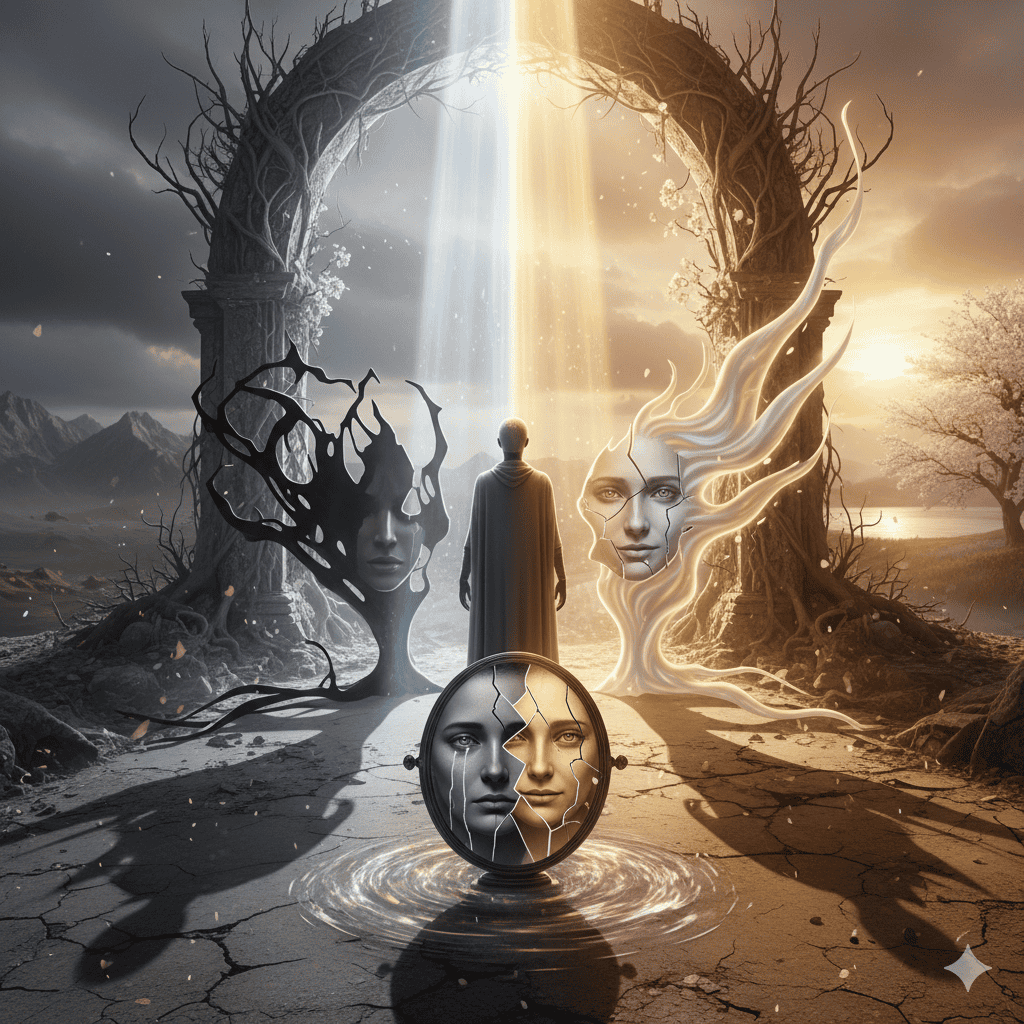
Art stands at the threshold of light and shadow, revealing the hidden dualities society refuses to face.
On the truths systems conceal, and the reflections only artists can reveal.
Art is the one witness society cannot silence. When institutions manipulate truth, when power disguises its hunger, when collective memory is rewritten or erased, art remains the ungovernable mirror. It reflects what systems attempt to hide: the tension beneath civility, the cruelty beneath order, the humanity beneath oppression. Through the artist’s eye, the world is revealed not as it claims to be, but as it is.
This is why art is so often censored, mocked, dismissed, or feared. A mirror is dangerous in any culture built on pretense — and the artist, simply by telling the truth, becomes a threat. Long before governments acknowledge their fractures, long before institutions accept their failures, artists feel them. Through creation, the buried fractures of society rise to the surface, becoming visible through brushstroke, verse, movement, image, or sound. Art captures what a culture suppresses, distorts, or refuses to confront outright.
To witness art sincerely is to encounter ourselves: our fears, myths, contradictions, and unspoken longings. It forces us to confront the shortcomings of systems and to see through the facades constructed by power. In this mirrored encounter, society is compelled — sometimes gently, sometimes violently — to face what it has long refused to name.
Art becomes not merely reflection, but revelation.
Not merely expression, but exposure.
Not merely decoration, but disruption.
In every generation, art carries forward a quiet revolution — reshaping consciousness from within, awakening the collective soul to its own truth.
II. The Artist as Witness and Warning
In every age, artists become the first to sense the tremor beneath the surface — the subtle fracture before the collapse, the quiet dissonance beneath the veneer of unity. Long before historians name an era, the artist has already felt its shift in their bones. They carry a sensitivity that cannot be domesticated, a perceptive instinct that registers what society attempts to mute.
This is why the artist is both witness and warning.
They stand at the threshold between the visible world and the subterranean one, translating the pressures, contradictions, and hidden wounds of their time into forms that cannot be ignored. Their work whispers what citizens privately fear, what governments suppress, what institutions deny, and what communities ache to express but cannot articulate.
Art becomes the record of everything a culture refuses to confess.
Where politicians revise narratives, artists restore them.
Where systems obscure harm, artists illuminate it.
Where power builds walls around truth, artists break them.
And because of this, the artist is always slightly out of place — too perceptive for comfort, too honest for conformity, too attuned to the soul of the collective to participate in its illusions. Their work does not merely reflect society; it reveals its shadow, its delusion, its yearning for transformation.
To ignore the artist is to ignore the early signs of decay.
To silence the artist is to invite collapse.
III. Art as the Conscience of a Civilization
Civilizations are remembered not for their wealth, armies, or empires — but for their art. Long after monuments crumble and rulers are forgotten, what remains are the stories, sculptures, myths, melodies, philosophies, and visions born from the creative mind. Art becomes the conscience that outlives the era that produced it.
This is because art speaks the truth of a culture, not the story it tells about itself.
A society that suppresses its artists suppresses its own conscience. Artists possess a moral sensibility that can awaken systems — they are the early warning signals, the voices that sense fractures long before institutions recognize them. They are instigators of movements, bridges between the grassroots and the intellectual sphere, connectors who translate the emotional undercurrents of a people into ideas, symbols, and truths. To silence them is to eliminate free speech and sovereign thought — and in doing so, a society amputates its own capacity to evolve. It becomes stunted, unable to face the mirrored reality that artists attempt to reveal.
A society that elevates only pleasing art elevates only pleasing lies. A culture in which creators make work to appease, flatter, or accommodate becomes a culture that butchers its own art — stripping it of reflection, purpose, and integrity. Art becomes an ornament that serves the system rather than interrogates it, praising what should be questioned, ignoring what should be confronted.
A society that fears truth will always fear its mirrors. And this systemic fear trickles down to individuals who also tremble before their own reflection. A culture built on control, anxiety, and emotional chaos produces conformists — people blinded by ego, insecurity, and self-preservation. Such individuals fear piercing truth. They fear the mirror. They fear the light that art carries. They cling to superficiality, preferring interactions that skim the surface rather than provoke rebellion or awakening.
And yet, art’s power lies in its refusal to obey. Even under censorship, exile, surveillance, or coercion, art finds a way. It bends, disguises itself, shifts its language — but it persists. The more truth is forbidden, the more urgently art seeks to reveal it.
For art is not merely expression.
It is memory — the living inner landscape of humanity made visible.
It is moral imagination standing against systemic oppression.
It is resistance made beautiful — not the beauty of decoration, but the beauty forged in fire.
It is truth allowed to breathe through metaphor when it cannot breathe through speech.
Art preserves what institutions attempt to erase, carrying cultural memory forward like embers smuggled through darkness. It ensures that even when an era lies about itself, future generations will know what truly lived beneath its surface.
IV. The Mirror That Changes the One Who Looks
To encounter art sincerely is to relinquish the comfort of ignorance. A true mirror does not flatter; it confronts. It reveals multiple facets at once, like a kaleidoscope — contradictions, wounds, hypocrisies — not to shame, but to awaken. Art does not seek to puncture the system with fatal holes; it seeks to reveal the cracks so those within it might awaken and transform through them.
Art transforms the viewer because it demands participation. It engages in a subconscious dialogue even when the mind appears still. It integrates with the inner psyche, stirring questions the viewer may not have language for. It challenges us to think beyond conventions, to step outside inherited structures, to push against the edges of the world as we know it. Art asks:
Where do you stand?
What do you consent to?
What truth have you abandoned?
Where do your values begin and end?
How will you engage differently with the society around you?
When a viewer feels disturbed, challenged, or unsettled, it is not the art that wounds — it is the truth it reflects.
This is why art becomes a catalyst for revolution, spiritual awakening, or social consciousness. It shifts perception, which shifts values, which shifts action. A single image can shake an empire. A single poem can ignite a movement. A single song can hold together a generation on the brink of disappearance.
Art is the mirror that changes the one who looks.
It is not superstition, nor prophecy — though it often foreshadows systemic fractures long before they erupt. Art amplifies what society refuses to confront, revealing truths differently to each person depending on their role, class, and identity. These revelations are often ignored until the mirror cracks, shatters, and reflects a reality too late to repair: a society unraveling into collapse, polarized, alienated, sick in spirit and structure.
Art reveals more than truth; it unravels illusions. And when the mirror reflects too deeply — when its light pierces the collective eye — society often attempts to erase it. Censorship becomes an attempt to hide the illness, the way a patient might refuse life-saving treatment.
By nature, art revolts. It initiates movements because the viewer is changed — and when the viewer changes, society follows. Slowly, subtly, irrevocably. Art awakens moral conscience and personal agency; it stirs the will toward liberation. It provokes thought where there was numbness, consciousness where there was denial, and action where there was passive obedience.
Art shifts energy — from silence to speech, from inertia to uprising, from conformity to truth.
V. The Risk and Responsibility of Seeing Clearly
For the artist, this role is not a chosen burden but an inherited one.
To create is to see.
To see is to know. To know is awareness.
Awarenss means responsibility.
Artists carry the responsibility of naming truths no one else will name, of preserving memories others will discard, of revealing fractures others will hide. They must stand firm in clarity even when that clarity isolates them, even when it makes their work difficult, dangerous, or misunderstood.
This responsibility is not heroic.
It is human. It is the function of living in society.
It is the consequence of having a sensitive conscience in a world that numbs its own.
And yet, the artist must also protect themselves. Mirrors fracture too. They themselves sometimes cannot shoulder all the burden to hold onto the heavy mirror.
To reflect society without being consumed by its wounds requires inner sovereignty — a sanctuary of spirit that cannot be infiltrated by cynicism, despair, or the corrosive demands of the system.
This is why the artist’s inner life is essential. This is why artists need to keep their spiritual world intact. In stillness, they can create and become whole. Artists can think critically without being coerced, influenced by external forces. Their art, their voice — pure, uncontaminated and inpenetrable by systemic pain and struggles. Art is the vessel that allows them to reflect the world without collapsing under its weight.
VI. Closing Reflection: The Mirror That Holds Us Together
In the end, art is the memory of humanity — the record of consciousness, struggle, beauty, cruelty, hope, and transformation. When everything else is stripped away, art remains as the final witness: the evidence that we tried, that we saw, that we felt, that we were alive.
Art does not merely reflect society.
It reveals us to ourselves.
To understand art is to come home — to stand before our own mirror and our own consciousness, to acknowledge it, study it, and let ourselves be moved by the light it casts. The mirror within art asks us to look again — more honestly, more tenderly, more courageously. It demands reflection with clarity and purpose.
Art becomes the inner fuel, the quiet engine of change. It sparks dialogue, provokes inquiry, and questions the integrity of the structures that govern us. Through this mirror, art becomes a pillar and a catalyst — the force that emboldens radical ideas, transforming them into movements for reform. It becomes the forum, the threshold, the ignition point for collective awakening.
It stirs sovereign souls into consciousness, pulling them from numbness into participation.
For without this mirror, we lose not only our truth —
we lose our capacity to awaken, to rise, and to change.
Comments are closed