Crisis and connection, sliced thin. An ordinary kitchen accident, an extraordinary lesson in the geometry of help and the necessity of boundaries.
This is the full version — layered with every detail, every pause, every conversation. For those who prefer a condensed read, a quicker, cinematic version lives on Medium.
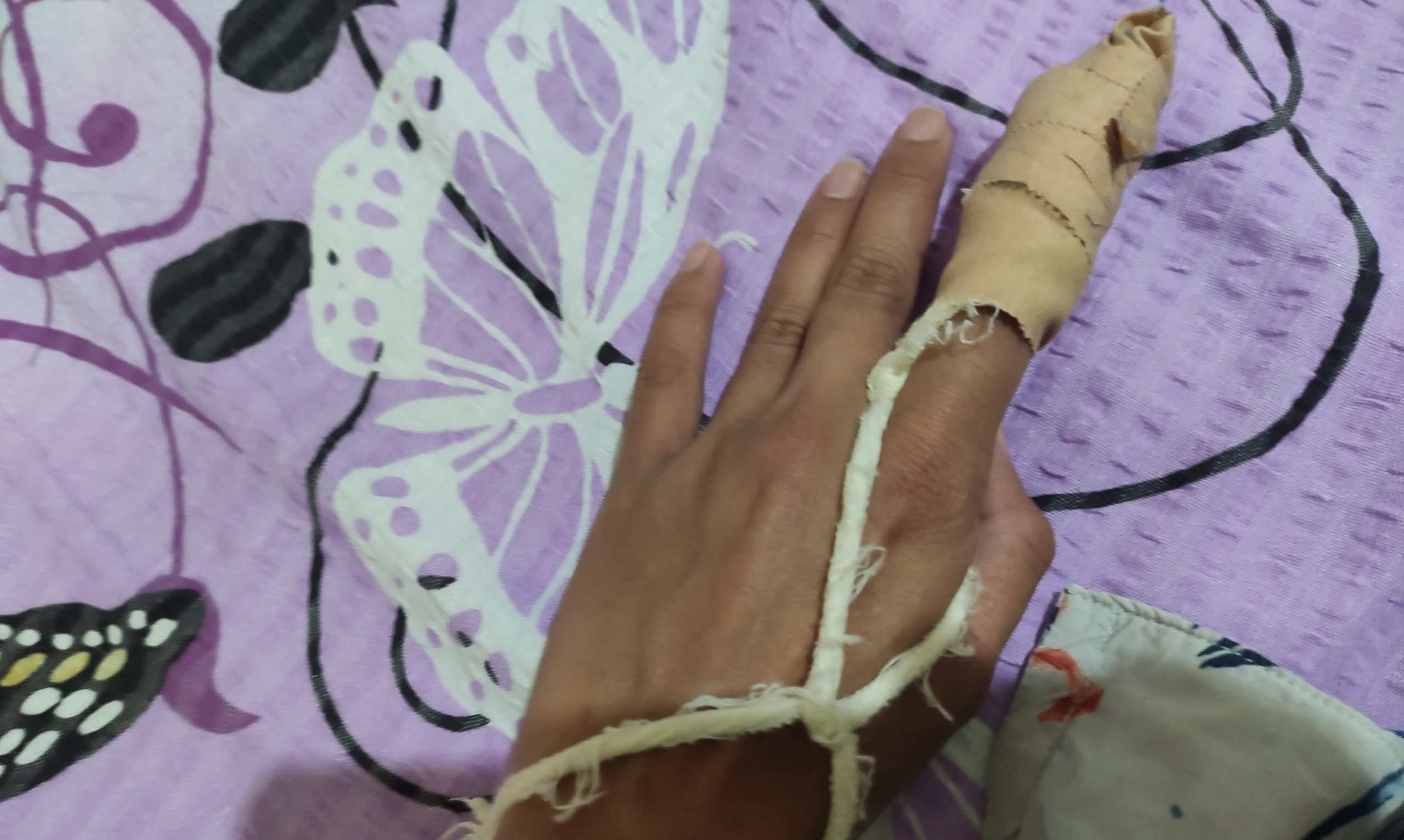
That evening, while slicing dried sausages wrapped in wax paper in my kitchen, my hand slipped. The knife cut deep into my finger. Blood poured, relentless. My first-aid kit was empty. Desperate, I knocked on my neighbour’s door.

“I’m showering,” came a distant reply.
“I’m sorry,” I said, “my finger’s bleeding a lot.”
Suddenly, another man appeared. I assumed he was part of the landlord’s family, but he was a tenant like me. His door was ajar, and when he saw my bleeding hand, he quickly offered cotton gauze, hydrogen spray, and a bandage.
“Dobroden…” I greeted.
He corrected me, “Dobreveche — bonjour, speak French? Parle en francais. Where you come from?”
“Canada — English,” I replied.
“Oh… I know it’s a stupid question but you mind me ask — how new are you?”
“35 and you?”
“70!” he replied.
“That’s twice my age. People like you in Asia are youthful, I can never tell the real age,” I said.
“Yes, I have Asian heritage,” I added.
“—Never mind,” he said, aware I was tired of being examined. Affectionately, he added, “Canada… my neighbour.” Startled, I took it literally: “Yes! I am your neighbour, but I don’t know the other guy — he seems North American, always watching US media.”
“But from what I’ve heard from Marko — he’s from France.”
“I’m Noam,” he said, “My last name is Martinovski. But call me Martin — girls in my school called me Martin.” I insisted on calling him Noam. He smiled warmly. I hesitated, surprised at the unusual first name for a Slavic man. He had been an engineer in New Jersey in the 1980s.
Noam’s improvised first aid was disconcerting. He started by binding the gauze with what seemed to be a piece of thin rope before wrapping the final adhesive tape with such force that it became a tourniquet. The extreme pressure was instantly painful, making the wound — and even the fingernail — throb, each pulse of my blood a pronounced beat beneath the tight binding.
Noam left his door open as he tended to my finger. My other neighbour, Benjamin, noticed. He gave a quick “Hi!” — a small attempt at connection — but I didn’t turn. I planned to speak with him later.
Returning to the kitchen, I saw Benjamin walking past with Bluetooth headphones, distant, unreadable. He hadn’t asked about my wound. I realized pride can overpower compassion, and even the simplest gestures can be misread.
Noam returned later, insisting on re-cleaning my wound and offering wine. At first, he saw me back in the kitchen and commented, “That’s your kitchen? You don’t have one inside? — It’s for everyone living here?”
I replied, “Yes, I like cooking here. Alone.” I didn’t respond to his second question, implying it wasn’t a necessary comment and that I didn’t need anything from him.
He persisted, asking me to visit him in two hours.
I tried to decline his offer to re-clean the wound politely, but he persisted, asking me to visit him in two hours.
His room was nearly empty, save for a bed. He spoke of family: a daughter in Qatar with a granddaughter in the UK; a son married with two boys. In his seventies, he cared for a wife who had suffered a stroke. He mentioned driving early from Struga to Skopje to run errands for his wife, picking up her medication since she refused to see a nurse. After completing his errands, he returned to Struga, continuing in solitude while awaiting the completion of his new “home away from home” — a house built just for himself near his birthplace in Ohrid. Though still married, he admitted he felt lonely.
He spoke with conviction about parenting: “We must teach our children independence. Hnewing on too tightly traps them. The world is theirs to discover.”
“So on paper, you’re still together?” I asked.
“To my children, yes — but I don’t live under the same roof. I don’t divorce; it avoids conflict and pain. Living apart makes peace easier.”
His words resonated, yet I couldn’t ignore a subtle unease — the way he carried himself hinted at red flags. I insisted on standing; he urged me onto the edge of his bed. As he wrapped my finger, he noted, “Your hands are cnew,” and reached to touch them. I pulled back. “It’s just the water,” I said.
He mentioned himself not believing in God, yet believing in a higher force. Noam is a pure science guy — fascinated by facts and science. When he asked why I was in Macedonia, I explained I was establishing myself for remote work — a stepping stone for my end goal of moving to Europe. Macedonia, I said, saved more on rent and food compared to Serbia, where I have more friends. I have no time for casual socializing, so Macedonia is perfect for focused work. Noam explained that his surgery made him leave America; otherwise, he would have stayed. He encouraged young people to pursue their dreams, emphasizing the importance of making one’s own choices.
Ignorantly and dubiously, he asked about my COVID experience. I explained that the West Balkans allowed me mobility without vaccine mandates and that all tests had been negative.
I added, “It has to do with the blood clot and the side effects in women in particular.” Still, he wasn’t convinced — he didn’t consider that chance or individual risk could be life-and-death factors for certain people like me. He said, “Makes sense, but it’s risky,” showing his strict scientific mindset.
He also shared about his wine: noticing a plastic bottle, I said, “So this is your homemade wine… oh, never mind, that’s from the market.” He smiled. “Actually, I make my own wine in Skopje. I’m building a new home here in Struga near my birthplace in Ohrid. My daughter and her husband bought a house near Lake Ohrid; they come by whenever to surprise me. I have my own life, they have theirs.”
At one point, he said, “I made my kids American citizens with American passports. I bring my wife to Skopje for support. But she doesn’t understand — feelings can change, and it’s too much to share space all the time. This is my house. She is just a guest sharing it, though she technically owns half even though I bought the place myself.”
I replied, “That’s understandable. Sharing space is difficult when people have different habits and tastes. When the feeling is gone, it’s gone — no going back.”
We shared wine and discussed music. “Everything,” I said vaguely — metal, opera, classical. He played an American female singer from 1965. I remarked, “That’s almost my parents’ age — they were born in 1961.” Then I handed the tablet back. He smiled and played Leonard Cohen’s Dance Me to the End of Love.
“The introduction sounds almost Slavic,” I said. “If on clarinet, it could be a Macedonian folk melody. Then it shifts — like an Argentine tango. Sad music, though they smile.”
“You’ve lived enough to hear music this way,” he said. “Artists borrow from everywhere.”
“Yes,” I replied. “Even from those long gone.”
For a brief moment, there was resonance — a fleeting, real connection.
I then played Led Zeppelin, Stairway to Heaven.
He then spoke about his health. Years ago, he underwent heart surgery — three bypasses. Initially resisting, he eventually accepted treatment. “Forty days later, I was back to normal,” he said. I shared my own pain tolerance: past untreated cuts, burns, and the challenges of bleeding and pain. He agreed, noting that severe burns remain the worst, even with care.
Eventually, I reclaimed my evening. I thanked him and left. No contact information; it wasn’t necessary.
The next day, Noam mentioned leaving to check on his house. While waiting for Benjamin, Marko passed by, explaining he was tidying for a new guest. Benjamin eventually emerged, and I saw Noam in the corridor. Unaffected by yesterday, he still greeted me, showing that respecting boundaries encourages mutual respect. Later, while cooking with the kitchen door open, Noam tapped on the glass pane to check on me. I gestured thumbs up, and he promptly returned to his room — honoring the boundary I established.
I closed the door immediately after the interaction ended.

Reflections
The night began with a simple kitchen accident and became an unexpected encounter with kindness, vulnerability, and subtle discomfort. Noam’s generosity was genuine, yet his boundary-testing reminded me to trust my instincts. Meanwhile, Benjamin’s reaction illustrated how easily silence can be misinterpreted. Yet after some space in his self-reflection, he came to a realization that his ego was overpowering his empathy.
In moments of crisis, people reveal more than we anticipate. Gratitude requires courage; asserting boundaries is essential.
The evening was a quiet lesson in the complexity of human connection — layered, unpredictable, and nuanced. Our instincts, our empathy, and our attention to boundaries remain among our most reliable guides.
No responses yet