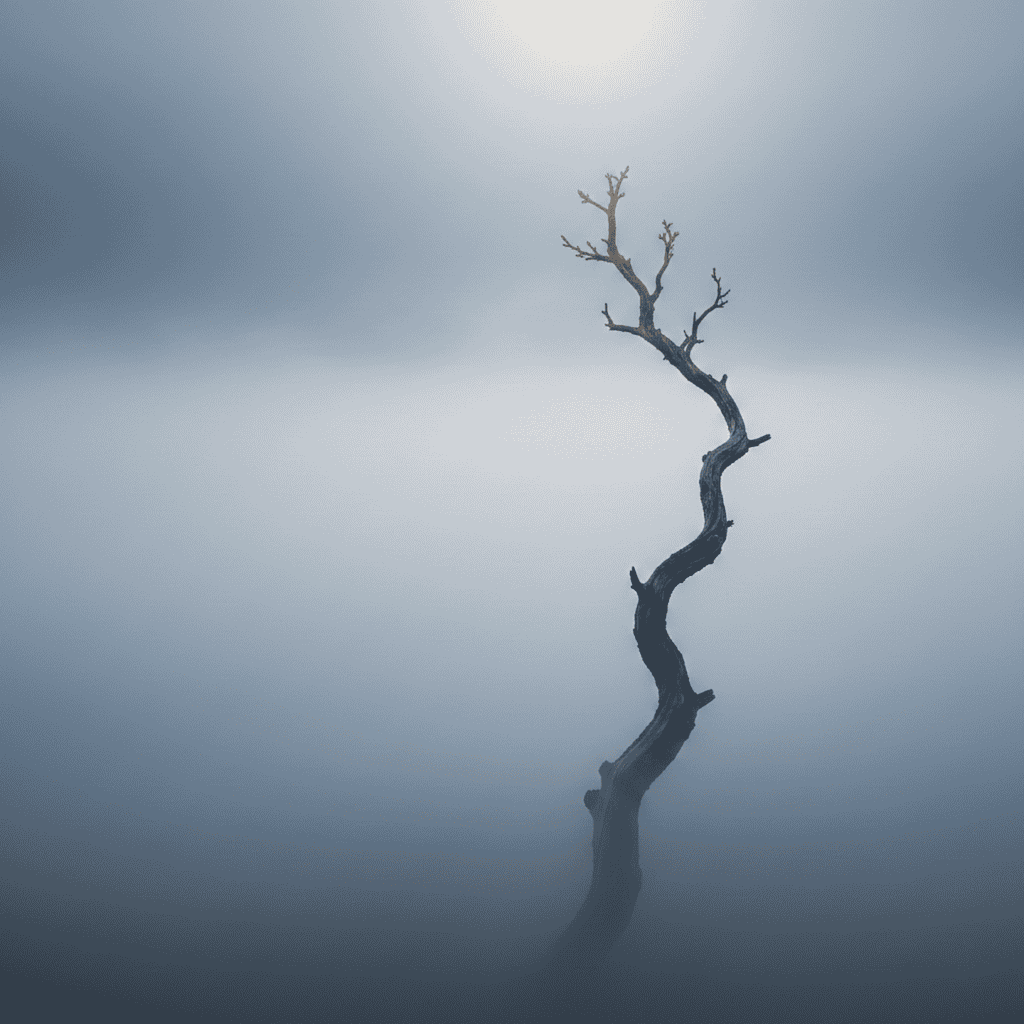
A solitary branch rising through mist — a symbol of the artist’s quiet sovereignty and the interior world that endures beyond systems.
A Treatise on Creation, Corruption, and Return
“The artist loses the world the moment they lose themselves.
To return to the interior is to return to truth.”
The Interior Sovereignty of Art
Where creation answers to nothing except the truth within.
Every authentic work of art is born from an inner territory untouched by the world’s demands — a sovereign space where the artist’s consciousness becomes its own compass. Before the opinions, the markets, the echoes of praise or dismissal, there is a quiet realm in which the soul creates for no one and nothing but the truth it recognizes. Here, art is not performance but revelation; not a product, but an emanation of being.
This essay continues my ongoing inquiry into the inner life of the artist — the unseen processes, the spiritual rigor, and the private negotiations between self and creation that shape the work long before it meets an audience. It stands alongside earlier explorations such as Art as Dialogue Between Creator and Creation and Artistic Legacy and the Fear of Disappearing as part of a larger meditation on what it means to create from within rather than from compliance.
Here, we turn toward sovereignty — the interior freedom that allows art to remain whole.
I. The System’s Hunger
On the Displacement of Art from Its Origin
Art begins in the interior — in the ungoverned world beneath language, beneath expectation, beneath the machinery of culture. It arrives quietly, like a pulse in the dark, asking to be shaped into form. Yet the moment it enters the realm of the external, it encounters systems that do not know how to behold it. These systems, designed for efficiency, profit, and spectacle, begin to reorganize art according to their own logic.
What they cannot comprehend, they attempt to classify.
What they cannot classify, they attempt to commodify.
What they cannot commodify, they attempt to control.
This is not hostility, but misalignment — a distortion born from the gap between what art requires and what systems demand. The system amputates depth not through violence but through indifference. It replaces mystery with legibility, authenticity with utility, transformation with performance.
It hungers for what art produces:
content, capital, identity, influence.
Like a parasite, it latches onto the artist’s neural pathways, offering funds, prestige, and belonging in exchange for spiritual compromise. It rewards compliance and calls it success. It demands output and calls it opportunity. The result is not merely professional distortion but existential dislocation.
Artists begin to deviate from their original calling, tethering their creative DNA to external incentives. The soul experiences famine. Creativity is cannibalized for survival. Integrity erodes incrementally. The artist climbs a ladder built from illusions of prestige — ascending farther and farther from themselves.
Systems celebrate this ascent.
But the soul does not.
True artistry becomes entangled in hierarchies that art was once born to disrupt. Institutions parade themselves as patrons of culture while propagating the very structures that starve it. Politicians adopt artistic aesthetics as façades for influence. Cronies launder power through cultural capital. In this theater, art becomes an accessory to corruption rather than an instrument of truth.
To systems, art is a resource to be mined.
To the authentic artist, art is a revelation.
And it is precisely this divergence that begins the fracture — the first tear between the interior world and the external one.
II. When Metrics Replace Meaning
The Slow Erosion of the Inner Compass
The artist’s inner compass is a subtle, delicate orientation toward truth. It listens. It hesitates. It demands care. But systems offer a different compass, one forged not from sincerity but from quantification: metrics.
Visibility becomes value.
Engagement becomes meaning.
Virality becomes worth.
The shift is gradual — so gradual the artist hardly notices when it begins.
At first, metrics are tolerated. Then they are consulted. Eventually they become the primary measure of success. A sentence becomes “good” not because it carries truth, but because it performs well. A painting becomes “successful” not because it reveals something essential, but because it sells quickly.
What once emerged from intuition begins to emerge from anticipation.
The unconscious is replaced by the algorithm.
The soul is replaced by the marketplace.
This is the quiet tragedy of artistic erosion:
the self-censorship that occurs long before the world demands it.
Most corruption does not look like betrayal.
It looks like adaptation.
It looks like exhaustion.
It looks like doing what seems necessary to survive.
But each concession bends the artist away from their original source.
Once metrics replace meaning, the inner world becomes a site of erosion — and erosion, once begun, is difficult to reverse.
III. The Artist as Commodity
How Systems Disfigure Creation
Art’s natural tempo is wild and irregular. It does not obey schedules or quotas. But systems require predictability, efficiency, and continuous output. And so they flatten creation into commodity.
Art becomes product.
The artist becomes brand.
The process becomes extraction.
The artist — once sovereign — evolves into a commander of surfaces. In this transformation, something sacred evaporates: the unpredictability of discovery, the quiet of incubation, the raw landscape of the interior world, the strangeness of experimentation, and the vulnerability of originality.
Systems reward artists who replicate, not artists who risk.
They cultivate compliance, not curiosity.
The artist’s inner life shrinks under the pressure of production speed.
Curiosity becomes an inconvenience.
Depth becomes a liability.
The artist becomes legible, marketable, and therefore, governable.
Creation no longer flows from revelation but from the supply chain of culture.
This is not merely a professional injury — it is a spiritual one.
Art becomes less an encounter with truth and more a function of demand.
But even as systems attempt to colonize artistic labor, there persists a quiet memory within the artist — a sense that creation was never meant to be consumed at this pace. This memory is the seed of resistance, though its flowering lies ahead.
IV. When Systems Shape the Inner Voice
The Internalization of Power and the Loss of Sovereignty
The most dangerous corruption is not external pressure but internalized logic. Systems infiltrate the psyche through inherited trauma, cultural narratives, and generational scripts posed as stability. Over time, the system’s values begin to govern the artist’s interior world.
The artist no longer asks:
What is true?
but rather:
What will succeed?
No longer:
What wants to emerge?
but:
What will be approved?
The artist listens not inward, but outward — toward imagined audiences, shifting cultural appetites, and the algorithms that dictate visibility. The interior world becomes a site of negotiation, not discovery.
Here, corruption becomes complete:
the artist silences themselves before the world ever needs to.
Fear disguises itself as professionalism.
Pragmatism disguises itself as wisdom.
Self-protection disguises itself as maturity.
The unconscious no longer guides creation; anticipation does.
The source becomes obscured.
The voice becomes divided.
Yet even in this disorientation, something remains untouched — the dormant, uncorrupted voice that preceded all systems. The possibility of return still lives.
V. Resistance Through Depth
The Return to Inwardness as Rebellion
Corruption is not fate.
It is only the shadow that appears when the artist turns away from their own depths.
Systems may distort the conditions of creation, but they cannot penetrate the interior unless the artist abandons it. True resistance begins not in rebellion against the external world, but in loyalty to the inner one.
Some artists choose this path: the path of depth.
They refuse the lures of belonging, immediacy, and applause.
They walk without guarantee of recognition or safety.
Their allegiance is to truth, not visibility.
Resistance begins the moment the artist turns inward — not through noise but through stillness, not through spectacle but through integrity. To resist is to create at the tempo of truth rather than the tempo of demand; to honor slowness in a culture addicted to acceleration; to guard the inner world against intrusion; to choose authenticity over performance; and to remember that art is a dialogue, not a product.
Depth becomes a shield.
Stillness becomes a boundary.
Silence becomes sovereignty.
When the interior world is reclaimed, the system loses its hold.
The artist becomes ungovernable — not through defiance, but through coherence.
VI. The Work Beyond Systems
The Ungovernable Nature of Authentic Creation
True art cannot be domesticated.
Its power lies not in its visibility but in its sincerity, not in its market value but in its ontological necessity.
Art that emerges from truth carries a frequency that systems cannot replicate. It unsettles, disrupts, awakens, reveals, and restores. It becomes a quiet force against corruption simply by existing beyond its logic.
The artist becomes the architect of an interior sanctuary — a domain of values and devotion unmediated by systems. They no longer negotiate their worth through external approval. Their allegiance is to the source.
Such art outlives empires.
Such art outlives systems.
Such art cannot be possessed.
Systems may shape how art moves through the world, but they cannot reach the well from which it is born.
For the source is interior.
Primordial.
Inviolate.
Closing Reflection: Returning to the Source
On the Sovereignty of the Inner World
The external world will always make demands — but it cannot define the terms of creation unless the artist grants it authority. The task is not to escape systems, but to refuse their governance over the soul. The artist must remain anchored in the interior realm where art originates, where intuition speaks, where sincerity is born.
Art predates culture.
It predates markets.
It predates every structure that seeks to commodify it.
When the artist returns to silence, they return to the source. They re-enter the primordial dialogue between the self and the unseen. Here, art becomes revelation rather than product, communion rather than performance.
To create from this place is to become sovereign.
Not sovereign over others, but sovereign within oneself.
Systems may influence how art travels through the world,
but they cannot touch the well from which art emerges.
Art remains untouchable —
so long as the artist guards their own heart.
Comments are closed