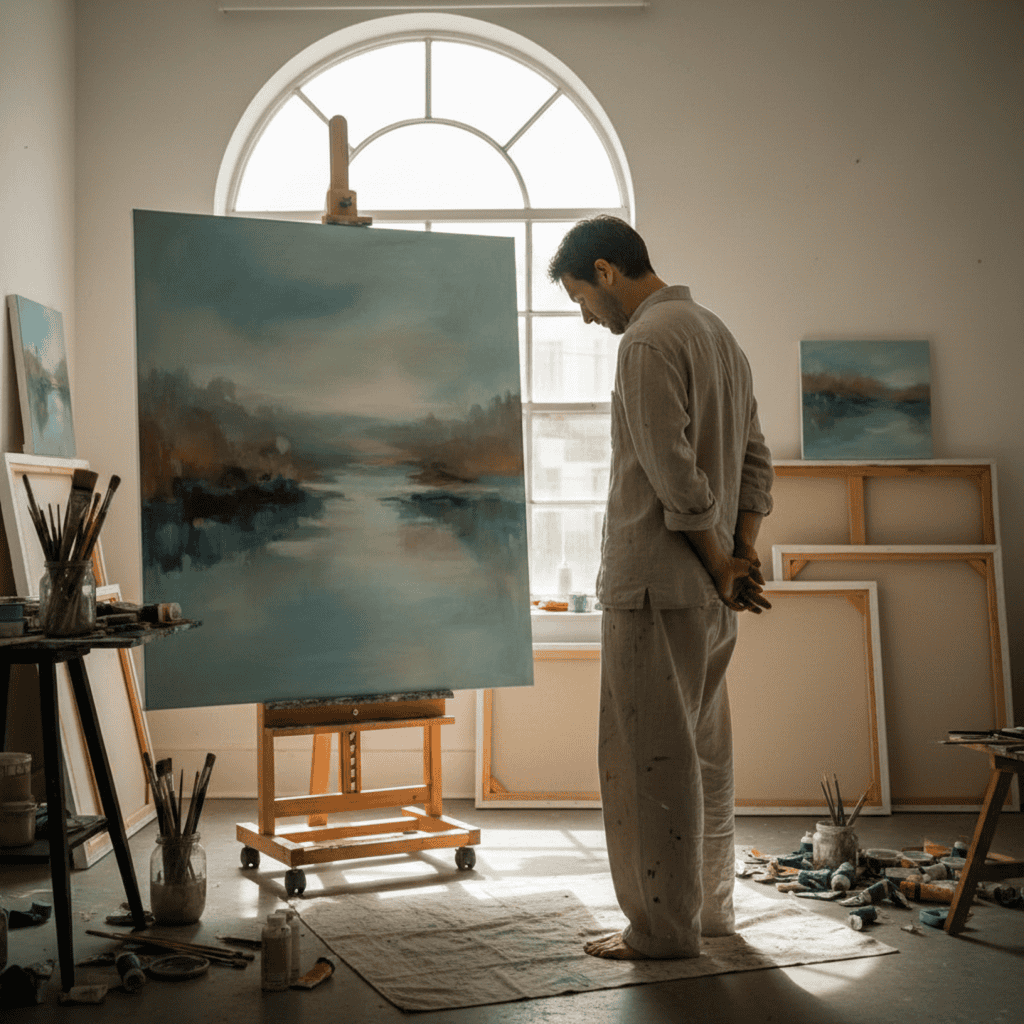
A quiet moment of communion — where the artist listens, the work responds, and creation reveals its next breath.
In the space between intention and emergence, something begins to breathe.
There comes a moment in every artist’s life when creation reveals itself as something more than an act — it becomes a relationship.
Beneath the surface of technique and intention, a quiet exchange begins to unfold: the artist shaping the work, and the work shaping the artist in return. What first arrives as a spark, a vision, a trembling impulse soon develops a presence of its own — hesitant, insistent, luminous, alive.
This piece continues the broader inquiry into the inner life of the artist — the same current explored in The Interior Sovereignty of Art, where creation is recognized as an act of inner freedom, and in Artistic Legacy and the Fear of Disappearing, where the artist confronts impermanence and the longing to be remembered.
But here, the focus shifts toward the intimate partnership between creator and creation — the living conversation that unfolds in the space between them.
For art is never a monologue.
It is an encounter.
A communion.
A mutual becoming.
And when the artist learns to listen — truly listen — the work begins to speak back.
Where intention meets intuition, and the work learns to speak back.
There comes a moment in every artist’s life when creation reveals itself as more than output. Art becomes a conversation — a subtle, evolving exchange between the creator and the emerging work. What begins as an impulse or vision slowly gathers gravity, temperament, and quiet demands of its own. The artist does not simply shape the work; the work shapes the artist in return.
Creation, when approached with sincerity, becomes a living dialogue — an unfolding intelligence that cannot be coerced or controlled. It arrives in fragments, whispers, and shifting signals that rise and retreat. The artist listens, responds, adjusts, and follows. Something is born between them, in the delicate space where intention meets intuition.
This dialogue is not always gentle. It resists ego, challenges certainty, and humbles the creator. It requires a willingness to be guided rather than to dominate — to listen rather than impose, to participate rather than perform. In entering this relationship, the artist steps beyond technique and into presence: the realm where the work becomes a companion, a mirror, and at times, a teacher.
The Work as a Living Presence
Every true work of art carries an inner pulse. It hesitates, redirects, contradicts. It pushes back. Sometimes it refuses to move forward until the artist changes — until they soften, deepen, tell the truth, or let something go. The work holds its own integrity.
The brush refuses to land in premeditated ways.
The sentence rejects cleverness and demands honesty.
The sculpture insists on remaining raw rather than refined.
In these moments, the artist realizes:
I am not making this alone. This is not cunning or craftiness. Art becomes true when my soul is present.
To create is to enter communion —
to participate in emergence,
to honor what wants to be born rather than what the ego wishes to display.
When the artist approaches the work with openness rather than force, the piece begins to reveal its direction — one they may not have anticipated, but that feels inevitable once found.
Surrendering Control, Strengthening Intent
A mature artist does not cling to the original idea. They understand beginnings as seeds, not blueprints. The true work grows as it must, shaped not only by vision but by the material’s own intelligence — the grain of the wood, the resistance of the page, the rhythm of the words, the emotional current rising unexpectedly.
To force the work is to kill its truth.
To surrender to it is to let the truth speak.
But surrender is not passivity.
It is a disciplined openness — a cultivated willingness to listen beneath the conscious mind. In this space, the artist reconciles two essential forces:
Intention, which grounds the work.
Intuition, which liberates it.
Purpose, which binds it with meaning.
When these forces meet, the dialogue deepens. The work becomes coherent yet alive, structured yet fluid — something neither artist nor material could have made alone.
The Artist’s Inner State as the Medium
Creation is shaped not only by technique but by the artist’s internal condition. The work absorbs everything: hesitation, clarity, fear, honesty, longing, truth.
An anxious mind creates anxious lines.
A fragmented self creates fractured meaning.
A present soul brings presence onto the page.
The artist must therefore tend their inner world with the same devotion they bring to craft. The work cannot carry a truth the artist refuses to inhabit.
In this sense, the dialogue is not simply between creator and creation — it is between the artist and their own being. The work becomes a vessel for the soul, and the artist becomes its steward.
As the artist matures, the dialogue becomes less about achieving and more about attuning — aligning the inner world with what the work requires, ensuring the work reflects who they are and what they stand for.
When Creation Pushes Back
Every artist knows the moment when the work resists: when the idea collapses, the direction dissolves, or the initial inspiration evaporates. This friction is not failure — it is communication.
The work is saying:
You are not listening.
You are forcing.
Your mind is exhausted from reproducing truths.
You are trying to skip the truth.
Resistance is the work’s demand for integrity.
A false line will not stand.
A dishonest passage will refuse to settle.
A plagiarized attempt collapses into hollow mimicry.
A rushed composition fractures under its own weight.
To respond, the artist must enter deeper honesty, deeper presence, deeper silence. They must return to why they began at all. They must meet the work where it is, not where they want it to be.
This is the sacred rigor of creation:
not perfection — but truth.
In truth, the artist’s soul radiates.
The Dialogue as Co-Creation
To recognize the work as a collaborator is to understand that creation is never a one-way act. It is a relationship. The artist brings vision, memory, devotion. The work brings form, resistance, rhythm. Together they discover what wants to exist.
Co-creation means allowing the piece to unfold naturally, to surprise the artist, to reveal the hidden, carnivorous inner-self no one else has witnessed. It means accepting change as part of the process — integrating mishaps, setbacks, and mistakes as lessons, becoming whole as an artist, becoming someone who embraces unpredictability.
It means trusting the work’s intelligence — continuing even without validation, even without applause.
It means listening for subtle shifts beneath the surface — tending to the self without harshness, recognizing that criticism carries energy, and only constructive criticism can be used to evolve the work.
It means letting go when the work asks for humility, resisting possessiveness, stubbornness, or fixation on one solution. Ideas must move freely, like water finding its path.
Co-creation is humility in practice.
Sovereignty without domination.
Devotion without possession.
This is how art becomes alive — not manufactured, but born. Not as an object, but as a being emerging through the artist in a quiet, divine union.
Final Reflection: The Quiet Partnership
In the end, art is not something the artist controls. It is something they meet — a presence they enter. A dialogue cultivated through discipline, silence, attunement, and sincerity. A meditation made visible. A crystallization of thought, emotion, and soul.
The creation is not merely a product; it is an embodiment of the artist — a trace of their becoming, a record of their courage, a refinement of their craft away from spectators and noise.
Creation speaks — softly, patiently, with a language older than words. It becomes a world born from inner realities, from ideas and theories and frameworks converging into form. All art flows from the same stream of consciousness, illuminated through solitude, introspection, and philosophical depth.
The artist listens — through intuition, stillness, and the willingness to be changed. They know art never stays static; it inhabits, evolves, and grows.
Between them, something emerges that carries the truth of both.
This is the real miracle of art:
not expression, but exchange.
not performance, but communion.
not invention, but revelation.
The artist becomes a vessel.
The creation becomes a voice.
And the dialogue between them becomes the path that shapes the work —
transforms the one who made it —
and moves the ones who witness its becoming.
Art, at its core, is the meeting point of soul and form —
a mosaic of the world,
an offering shaped by the divine.
Comments are closed