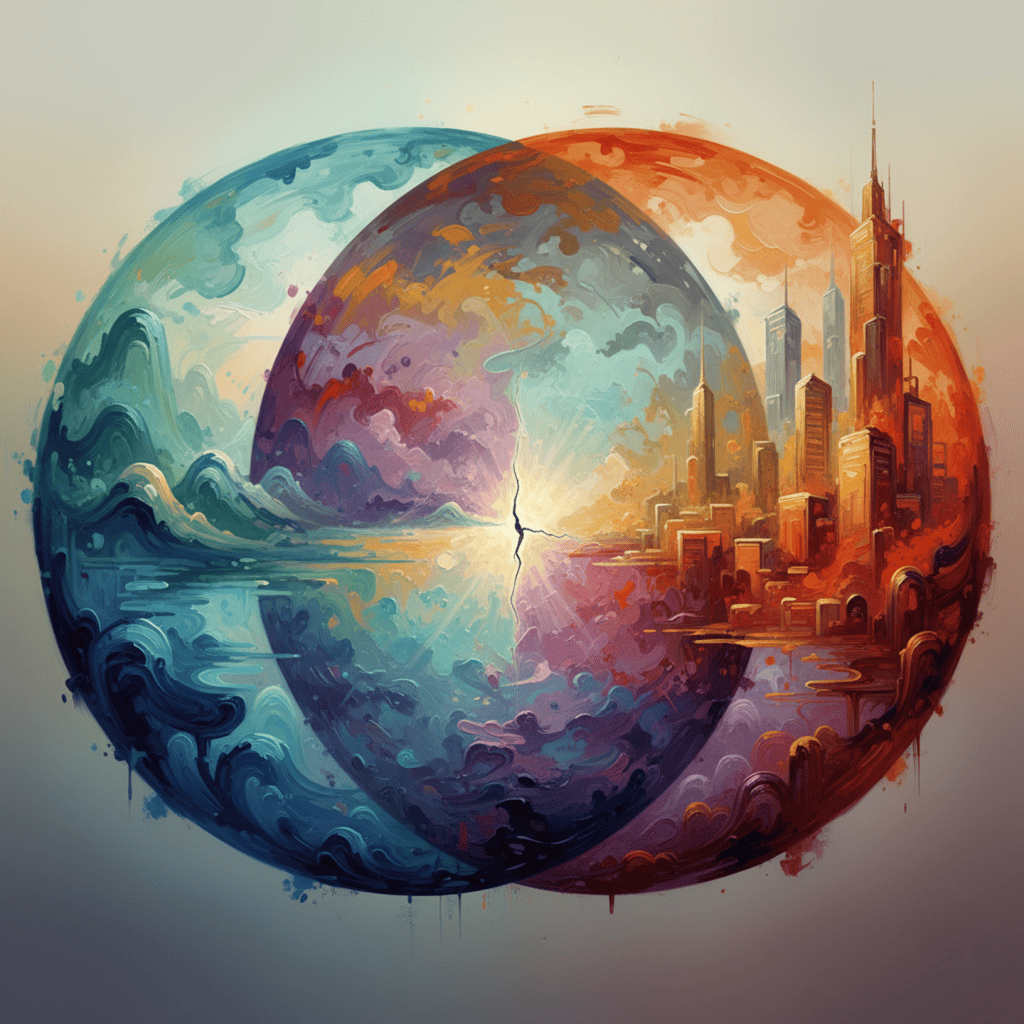
A symbolic fusion of East and West—two worlds in tension, yet moving toward integration. A visual echo of the cultural paradox explored in this essay.
At the Threshold of Two Worlds, I Learned to Carry My Own Light
A continuation of the story first shared in “In-Between Worlds: The Criminal of the Hybrid Soul.”
There are some journeys that begin before language, movements of the soul that only later become sentences.
My earlier essay on Medium — “In-Between Worlds: The Criminal of the Hybrid Soul” — explored that first rupture: the tension of belonging to no single culture, the liminality of identity, and the spiritual turbulence of awakening between East and West.
What you read now is the next step in that unfolding.
If the first piece exposed the architecture of a hybrid soul, this one enters the interior rooms — the emotional entanglements, the creative silencing, the cultural fractures, and the painful mirrors that shaped my becoming. It moves from the philosophical into the lived, from abstraction into the visceral terrain of relationship, family, trauma, and the slow reconstruction of selfhood.
The Medium essay was the threshold.
This article is the passage through it —
into paradox, into clarity, and into the quiet reclamation of a voice once dimmed
Solitude and Awakening
It is ironic that awakening arrives cloaked in solitude — in melancholy, silence, and the rumination of ego, the invisible walls we build between ourselves and ordinary society. Yet it is within this raw, self-contained space that compassion blooms, humility takes root, and the possibility of reconciliation quietly appears — even under the weight of tradition pressing from my Eastern parents.
Awakening is not graceful.
It does not unfold as a gentle expansion.
It shatters, exposes, disorients.
And yet, this harsh clarity guides me home.
It calls me to honor my roots, to embrace the duality within myself: light and shadow, East and West, stillness and movement. It frees me from the shackles of judgment, from grudges long carried, from the fear of being misunderstood.
It is through paradox — not perfection — that the self begins to open.
Mirrors of the West and the East
Not all Westerners respond with projection or envy, but simply by existing between cultures, by carrying my energy as someone who is neither entirely Eastern nor entirely Western, I reveal unspoken dissonances in others. Sometimes the reflection is harsh — an uncomfortable mirror held up too brightly to ignore.
My family, structured and devoted to planning life, often lost sight of meaning when absence and cultural misalignment grew between us. My impulsive search for validation in the West, my alignment with my ex’s ambitions, my critique of tradition — these things struck at the spirit of my heritage. I acted superior, dismissive, scorning what I did not yet understand.
And yet these tensions birthed depth.
My Chinese ex, immersed in anti-spiritual rhetoric, insisted that success required total assimilation into Western logic. Eastern philosophy, to him, was incoherent, inefficient, outdated. Yet under the pressure of this arrogance, an unexpected truth revealed itself: the East is not a barrier. It is a co-creator, a mode of presence, a vessel of relational intelligence.
He was not Ukrainian — his roots were Chinese, born in Hong Kong and raised in Canada, shaped by the quiet violence of diaspora assimilation and the lifelong pressure to transcend heritage through Western logic. His spirituality was aesthetic rather than ancestral: a curated chaos, a performance of freedom staged through festivals, visuals, and the mythology of psytrance culture. He dismissed Eastern philosophy even as he unconsciously reenacted its discipline; he sought Western validation while drifting at the margins of belonging. In this, he echoed my family more than either of us understood — another culture, yet the same emotional architecture, the same dependence on external structures to define identity, the same rigidity disguised as certainty.
What unfolded between us was not toxicity, but a subtle, unspoken competition — the kind that emerges when two privileged Asian diasporic souls seek depth, authenticity, and reinvention in the same foreign landscape. We were not fighting each other; we were fighting the shadows of our upbringings, the pressure to transcend our origins, the hunger to claim Europe and the Balkans as spaces of self-creation. He expressed this through aesthetic spirituality and subcultural mastery; I expressed it through emotional excavation and philosophical exploration. It was the same ambition, shaped by different wounds.
Though he sees integrating aesthetics into his spirituality as a necessity — the new-age flamboyance, the vigour of the social pulse, the music — within that circle it helps him connect with artists and organizers, fuelling his social capital and affirming his place in psytrance culture and spiritual appearance. Hungary became his chosen ground — where he discovered the genre, shared smoke-filled conversations with locals in dim bars, and surrendered to the swell of festivals — and later Serbia too, a haven he claimed as his own. And so an unspoken arrangement emerged between us: he lingered on Serbia’s edges, drifting into Belgrade when his mood aligned, while I moved through Greece and sometimes Poland for Summer Contrast — that enchanting, almost bewitching fusion of the psytrance light-scene and visual art, a softer pulse where creativity found breath.
Looking back, I see now that our migrations were not wanderings but reflections — each tracing a hidden symmetry neither of us could name at the time.
A softer truth revealed itself in the background of our divergence.
Despite their rivalries and contradictions, East and West converge in ways neither side fully admits.
The East lends precision, continuity, and holistic integration.
The West offers creativity, innovation, and entrepreneurial daring.
Together they form a practical harmony — a metaphor for the human spirit itself.
Family, Allegiance, and Cultural Turmoil
A few years ago, my parents absorbed my ex’s hostility. They believed he manipulated me with Western logic, “abducted” me, hid me from them. In reaction, they swung to the other extreme — blaming the West for global misfortunes, world conflicts, disruptions to our family system.
My mother, rooted in a grassroots upbringing, shared state propaganda as truth. My father, who desired Western comfort after retirement, still upheld loyalty to the party through his telecom affiliation.
Their ideology contradicted itself, yet both clung to it with a fervor shaped by fear, ancestral duty, and cultural pride.
To them, even maintaining a friendship with my ex became an unforgivable betrayal.
My refusal to choose East or West — my insistence on inhabiting a liminal space — threatened the family’s psychological architecture. And so I drifted into a spiritual no-man’s-land, a space where belonging to neither side was both exile and liberation.
It was in the Slavic world that I found sanctuary — a resting place for the culturally displaced, a home for those who belong everywhere and nowhere at once.
The Bridge to the Personal
But these reflections — these philosophies about culture, ego, and awakening — were never conceived in abstraction.
They were forged in the most intimate crucible of my life:
a relationship that became both mirror and wound.
Before I understood paradox, I had to survive it.
Before I embraced liminality, I had to live it in my own body.
What follows is not detour, but origin.
In those years, I was not the only one absorbing his emotional overflow. Before me there were fragments of the same pattern — Peter, then Jenya, and finally Alex. Each relationship reflected a different stage of his search for identity.
Péter, a Scorpio and a front-end web designer, offered him intellectual validation. But my ex quickly recognized Peter’s limitations — his Leo moon made it hard for him to sustain long stretches of energy at parties, even though he possessed a quiet, intricate artistry in sound design and music composition. His music was intimate, crafted for a small circle of people he trusted. Like me, Peter disliked marketing — the performative self-promotion that psytrance culture so often demands, the insistence on making one’s work appear larger than it is.
My ex was drawn to Peter’s dark past, shaped by a former Hungarian partner who had been an avid psytrance music producer. He admired how Peter cared for him: gathering organic herbs and vegetables, preparing wholesome meals, and bringing a kind of grounded domestic ritual into their days. Together they had vigorous, sprawling conversations about sound, texture, and the architecture of music. It was through Peter that he first awakened to the psychedelic terrain of acid in the woods, discovering the flavour of the genre and the groups he longed to immerse himself in. He wanted Peter to enter the community more fully, to be seen — yet despite over a decade in the scene, Peter remained peripheral, secretive, uninterested in visibility. My ex showed Peter’s work to others, but almost no one recognized his name. And in that contrast — the social butterfly Libra versus the mysterious, subterranean Scorpio — their divergence became clear.
Then came Jenya, whom he met in Thessaloniki — a Cancerian who offered cultural proximity and emotional warmth. At first he was drawn to Jenya’s own liminal identity: a Ukrainian with a Russian passport, carrying the emotional fracture of having family divided between Ukraine and Russia. But soon he began to retreat, claiming Jenya was “too attached,” too clingy, too dependent on reassurance. He dismissed Jenya’s lack of long-term vision, his work in a cafeteria, his uncertainty about the future — and eventually withdrew once more. In the end, Jenya rooted himself in Greece and found someone local.
And finally Alex arrived — a Russian artist with Lithuanian roots, whom he met in Belgrade — offering the creative and astrological resonance he had long sought. He once told me in vivid detail how their energies aligned: his Virgo pragmatism and entrepreneurial discipline complementing Alex’s Sagittarius spontaneity and Capricorn-moon devotion. He said their connection was “beyond the ordinary,” a bond driven by growth, the kind where both people “get” each other effortlessly. Intuitively, I understood where he was heading — toward a synthesis of entrepreneurship and artistry he had always longed for.
Yet despite the new relationship, he and Peter remained close. When Alex couldn’t travel to Hungary due to visa issues, Peter became his primary companion — the one who joined him at Ozora and the Sun Festival, moving with him through the pulse of crowds and the long, hypnotic nights of psytrance.
Looking back, I see now that none of us were rivals. We were mirrors, each carrying a piece of the identity he was trying to assemble from the outside in.
Entanglement: The Relationship That Reflected My Shadow
At one point, my ex and I fell into an entangled relationship — enmeshed, co-dependent, caught in a cycle where I absorbed his emotions and justified his abuse as a consequence of my own inadequacy. It was an unhealthy feedback loop, revealing what each of us lacked. He feared vulnerability, lacked compassion. I lacked the emotional containment necessary to redirect my inner turbulence toward art or writing.
I believed I was never good enough at work.
I kept forcing myself to learn tech, data engineering, anything that might earn competence in his eyes.
But each attempt left me feeling more depleted.
To him, my struggles confirmed that I “did not belong” in that world. His solution was always structural — legal entities, systems, frameworks. Meanwhile, I spiraled into depression, convinced my art was useless, my inability to adapt to North American norms an inherent flaw.
But emotional unsafety masquerades as personal failure.
When someone you love invalidates you, withholds compassion, or shifts responsibility onto you, your nervous system survives by believing you must be the problem.
That is not weakness.
It is survival.
It is trauma-bonding.
Nothing about his behavior was mine to carry.
Erosion: Work, Identity, and Emotional Exhaustion
He grew tired of my relocations, tired of what he saw as “failures.” When clients questioned my expertise, he deemed us professionally incompatible, dismissing the overlap between tech and analytics.
I was building a life, a career, and a relationship all at once — under the scrutiny of someone whose approval mattered but was never offered.
My identity fused with his perception of my worth.
My competence lived or died by his reactions.
In that psychological climate, I burned out.
I shut down.
I sought refuge in bed.
My creativity evaporated.
My artistic energy, already fragile, dissolved under criticism.
But his frustration was not my failure — it was the limit of his emotional capacity.
He was not guiding me toward growth. He was pushing me toward outcomes aligned with his worldview, his pace, his definition of competence. When I diverged, he interpreted it as failure.
We were not professionally incompatible — we were emotionally incompatible.
Chaos in Disguise, Order in Disguise — Mirrored Architectures
In hindsight, his vigour in embracing the psytrance community revealed another paradox — one that mirrored my family more than either of us understood. My parents clung to tradition, to structure and lineage; he clung to aesthetic spirituality, to the performance of freedom under neon lights. Both were forms of rigidity disguised as certainty. Both relied on external systems to define identity. And in both, paradox was celebrated only in theory, not in practice. His ‘chaos’ was curated, socially rewarded, as governed by unspoken rules as my family’s loyalty to order. It was the same architecture in different clothing — the same emotional inflexibility that neither of us could transcend.
Cultural Paradox Within the Relationship
Ironically, in later years, he began recognizing the value of cultures outside mainstream Western norms. After living abroad, he realized rigid systems starve creative thought.
This was the unspoken truth we always shared:
cultures that embrace paradox, ambiguity, and chaos produce people capable of thinking broadly, holistically, fearlessly.
Yet even this shared understanding could not save us.
Our emotional foundations were misaligned:
hierarchical, critical, compassionless, performance-based.
A relationship cannot transcend its own emotional architecture.
Croatia, Synchronicity, and the Karmic Mirror
Croatia became our crucible — a landscape of contrasts where world conflict, Slavic suffering, and global injustice sharpened my empathy into something overwhelming. I felt the grief of nations, the psychic turbulence of the world.
Synchronicities began to shimmer:
a SIM card, a number, a whisper of a twin flame — a resonance I would only later understand.
Meanwhile, my ex confronted his shadow in the mirror of our hybridity. Born in Asia, raised in the West, he measured himself against my liminal identity. He proclaimed superiority, yet was drawn to the depth he once ridiculed.
The irony completed itself when he found a Russian artist as his partner — the same cultural fluidity he condemned in me became the terrain he later sought.
Silent Observation
When he silently unblocked me on social media, it felt like an invitation — and a prohibition. He wished to observe, not engage. Perhaps he hoped I would not “expose” him to my family. Perhaps he sensed transformation.
Or perhaps, on some level, he recognized the spiritual depth he once tried to suppress.
The silence between us became a boundary of respect, not resentment.
Labubu: A Symbolic Bridge Across Worlds
Synchrony appeared again when my mother showed me her Labubu doll — encased in plastic, placed beside books on God, language, and spirit.
It echoed a memory from Albania, where two children, Amelia and Perla, held blue and beige Labubu dolls, calling me an angel. A moment of innocence, healing, and connection.
A Russian song — ЛАБУБУ (2025) — reinforced the symbolism.
Labubu was not just a toy.
It was a bridge across cultures, hearts, and spiritual states.
Sometimes grace arrives in plastic.
Trauma, Creativity, and Rebirth
What happened in my relationship was a form of creative trauma — not physical danger, but the slow erosion of:
confidence
expression
spontaneity
cognitive flexibility
joy in creation
Trauma does not need violence to dismantle the artist.
I did not fail.
I was depleted.
What I feel now is the aftermath — not the truth of who I am.
And I am relieved I can articulate all of this with clarity.
I am emerging from the fog.
I understand the dynamics now.
I am reconnecting with myself.
I am ready to heal.
I am ready to be.
The Path of Paradox
Over time, I have learned to see paradox not as contradiction, but as guidance.
Light and shadow coexist.
Cultures intertwine.
Hearts resonate across borders.
Growth emerges from conflict as much as stillness.
Integration does not require erasure;
healing does not require purity.
Spirituality, empathy, and reflection weave meaning — bridging East and West, self and society, suffering and awakening.
Conclusion: Ego and Integration
The journey home is not transcendence alone, nor collapse into despair.
It is reconciliation:
with heritage
with ancestry
with East and West
with light and shadow
with ego and humility
The ego can imprison or it can be integrated.
The shadow can destroy or it can be seen with compassion.
Awakening is not the absence of darkness.
It is the willingness to hold it.
To walk this path is to ask:
Will I be consumed by my shadow,
or will I carry both sides — dark and light — with integrity?
That is the paradox.
That is the liberation.
Comments are closed