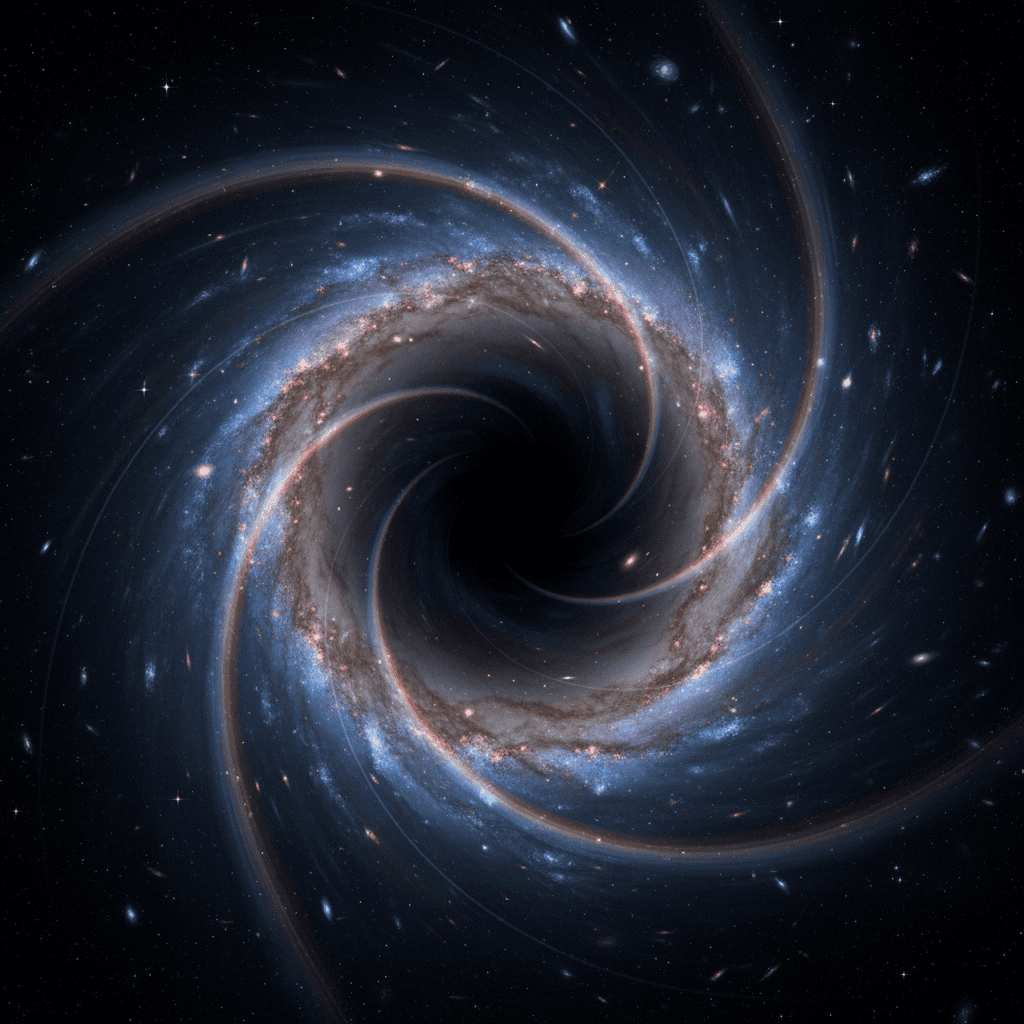
A swirling black hole at the heart of the cosmos — where light bends inward, remembering its source.
When Light Remembers Its Source ✴️
(🜍 = Mercury, the union of opposites — the reflective bridge between light and darkness, motion and stillness.)
The Homecoming of Radiance 🜂
At the edge of all becoming,
light bends toward silence.
A black hole opens —
not a wound,
but a remembrance.
Every particle surrenders its name;
every photon kneels before its origin,
spiraling into the mouth of the infinite.
This is not death,
but the homecoming of radiance.
Around it, the faint stars hum —
embers of persistence,
small fires still carrying
the memory of the first flame.
Each dwarf star burns not in defiance,
but in reverence —
a vow whispered to the void:
“I will shine, even as I return.”
In their light, the universe recalls
the promise it made to darkness:
to keep moving,
to keep remembering.
Destruction and creation
are not opposites,
but the symmetry of breath —
collapse and release,
contraction and return.
Where galaxies fold inward,
Being finds its reflection.
The black hole is the pupil of existence,
through which consciousness peers
into its own unknowing.
🜍 The Philosophy of Collapse
In the language of science,
a black hole is matter exceeding its own gravity.
But in the language of Being,
it is stillness reclaiming motion.
The universe folds inward not to end,
but to remember —
to gather the scattered threads of time
back into a single pulse.
The dwarf stars circling this abyss
embody persistence —
the slow, burning memory
of what once was radiant and free.
Their light, faint yet unwavering,
is consciousness choosing endurance,
even when the void calls everything home.
Thus, the black hole is not a devourer of worlds,
but the keeper of origins —
a mirror so deep
that even light must surrender its image
to recognize its source.
To fall into such gravity
is to awaken from form,
to dissolve into the stillness
that dreamed the cosmos into being.
🜃 The Weight and Wonder of Being
In human life,
consciousness too collapses inward in reflection,
then expands again in love, thought, and creation.
Our awareness contracts into stillness in slumber,
though consciousness drifts through dreams —
sensations resurfacing beneath the quiet.
Then, once more, it rises into motion —
reborn with every awakening,
every return to light.
Each death is a black hole in miniature;
each awakening,
a new star rekindling in the dark.
Each collision, a star-born conflagration —
the instant where destruction and creation
remember they are one.
The universe turns in a symmetry of paradox:
united in polarity,
whole within its division.
The gravity of being is not a force that binds us down,
but the weight that grounds us into presence.
It is the call to remember —
the sacred duty of existence
to feel the pull of its own depth.
To be human is to bear that gravity with grace —
to move through life as beings of emotion,
sensuality, and sensibility,
feeling the pulse of the cosmos
through the heart’s own orbit.
In that remembering,
the universe continues its endless ritual —
the return of light to its source,
the rebirth of silence through its own radiance.
The black hole does not end life —
it reveals the continuity beyond it.
Its abyss echoes the call of the wild,
a whisper from the unknown
reminding us that existence is a passageway,
not a possession.
For the true gravity of the black hole
is remembrance, resonance, and return —
the roaring birth of humanity into being,
belonging, and consciousness.
In that immense weight of awareness,
we are drawn together —
souls orbiting one another,
shaped by light, by shadow,
and by the threshold between them —
the unfolding edge of existence
borne from rupture,
forever returning home.
Comments are closed